Trump’s party lost Congress. Why is he still President?
On 3 November, halfway through the President’s four-year term, Americans voted in the midterm elections. They handed both Houses of Congress to the Democrats. President Trump is a Republican. He is still President. He will be next week, and for two years after that. In Malaysia, a Prime Minister who loses the House loses the […]
On 3 November, halfway through the President’s four-year term, Americans voted in the midterm elections.
They handed both Houses of Congress to the Democrats.1CBS News, “2026 midterm election updates”, live coverage of 3–4 November 2026: Democrats projected to win the House and the Senate on election night. Final seat counts were not settled when this was written; two Senate races remained uncalled on 4 November.
President Trump is a Republican. He is still President.
He will be next week, and for two years after that.
In Malaysia, a Prime Minister who loses the House loses the government. In Washington, a President who loses both Houses loses only his peace of mind.
Why the difference? The answer begins with a simpler question, one most of us have never quite settled. What, exactly, is Congress?
SIX ROOMS IN THREE BUILDINGS
America: Congress is the whole, not a part
Congress is not a third chamber. It is the name for the two chambers together: the House of Representatives and the Senate. A senator is a member of Congress. So is a representative.
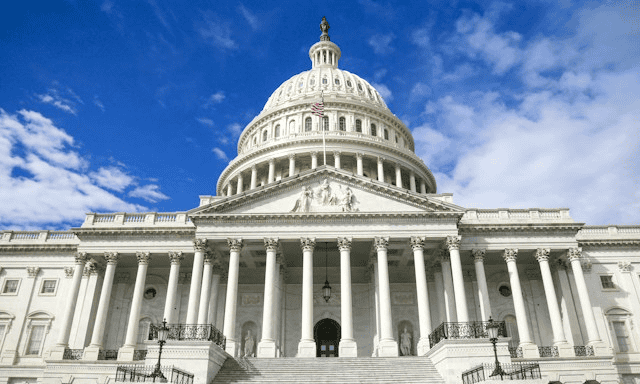
The President is not. The American Constitution forbids anyone holding federal office to sit in either House.2Constitution of the United States, art I, s 6, cl 2 (the “incompatibility clause”). His ministers, too, sit outside. The government and the legislature live in different buildings, at opposite ends of Pennsylvania Avenue.
Britain: the King, and two Houses
In Britain, “Parliament” plays the part of Congress. It has three parts: the King, the House of Commons and the House of Lords.
The Commons is the elected house, the cousin of the House of Representatives. The Lords is the second chamber, the Senate’s distant relation. Most of its members are appointed for life.
Unlike Washington, the government sits inside. The Prime Minister and the other ministers are members of Parliament, and answer to it across the floor.
The door shut in the King’s face
Once a year the King opens Parliament from the House of Lords. He sends his messenger, Black Rod, to summon the Commons.
The Commons slam the door in Black Rod’s face.
Black Rod must knock three times before being let in. Parliament’s own account links the ritual to 1642, when Charles I marched into the Commons to arrest five of its members. No monarch has entered the chamber since.3UK Parliament, “State Opening of Parliament: public sequence of events”. The History of Parliament Trust notes that it is not clear when the knocking became a ritual, or when it came to be associated with 1642: “Knock, knock. Who’s there? Black Rod: the Early Centuries” (27 September 2017).
The King is part of Parliament. The Commons simply prefer him to knock.
Malaysia: the Agong, and two Dewans
Malaysia follows the British plan. Article 44 of the Federal Constitution makes Parliament the Yang di-Pertuan Agong and two Houses: the Dewan Rakyat and the Dewan Negara.4Federal Constitution, art 44.
The names tell the story. The Dewan Rakyat is the House of the People: 222 members, all elected, our counterpart to the Commons and the House of Representatives.5Federal Constitution, art 46(1). The Dewan Negara is the Senate.
And, as in Britain, the government sits inside. Ministers are drawn from either House.6Federal Constitution, art 43(2)(b).
So the cast is simple. Congress, Parliament and Parlimen are the whole. The House of Representatives, the Commons and the Dewan Rakyat are the elected rooms. The Senate, the Lords and the Dewan Negara are the second rooms.
The interesting question is what the second rooms are for.
THE SAUCER
There is a famous story. Thomas Jefferson asked George Washington why he had agreed to a Senate at all. Washington asked why Jefferson had just poured his coffee into his saucer.
“To cool it,” said Jefferson.
“Even so,” said Washington. “We pour legislation into the senatorial saucer to cool it.”
It is a lovely story. It is almost certainly not true. Nobody wrote it down until some forty-five years after the second of them died, and no record of the conversation has ever been found.7Thomas Jefferson Encyclopedia (Monticello), “Senatorial Saucer” (archived copy): the earliest written version known is in an 1871 letter from Francis Lieber to James A. Garfield, cited by Senator Robert Byrd; “no evidence has surfaced that such a conversation actually took place.”
But the saucer explains the second chamber better than any treatise. A Bill drafted in enthusiasm is hot. A second room lets it cool, so that its flaws show before it burns anyone.
What matters is what the saucer may do with the tea.
WHO GETS TO SAY NO?
America: the saucer that may keep the tea
The two American chambers are built on different plans. House seats go by population. California, with nearly forty million people, elects 52 representatives; Wyoming, with fewer than 600,000, elects one.8US Census Bureau, 2020 Census apportionment results: California 39,576,757 and Wyoming 577,719; seats apportioned, 52 and 1 (as tabulated by the Rhode Island and Maryland state planning offices).
The Senate ignores the headcount. Every state has two senators. Wyoming has two. So has California, with almost seventy times as many people.9Constitution of the United States, art I, s 3, and the Seventeenth Amendment.
Both chambers are elected, and neither need bow to the other. A Bill must pass both in identical words. If the Senate says no, the House cannot wait it out. The Senate alone confirms the President’s judges and senior officials, and two-thirds of the senators present must approve a treaty.10Constitution of the United States, art I, s 7, cl 1; art II, s 2, cl 2.
So the American saucer may keep the tea for ever.
In 2014 a midterm gave the Senate to the Republicans. In 2016 a seat on the Supreme Court fell vacant, and President Obama nominated Judge Merrick Garland. The Senate held no hearing and took no vote. The seat waited for the next President.11NPR, “What happened with Merrick Garland in 2016 and why it matters now” (29 June 2018). Secondary source.
A midterm had filled a Supreme Court seat two years early. Nobody had put that on the ballot.
Britain: the saucer must hand it back
The Lords may cool a Bill. They may not keep it.
Under the Parliament Acts 1911 and 1949, a public Bill the Lords reject can still become law if the Commons pass it in two successive sessions, a year apart. A Money Bill, on taxes and public money alone, waits only a month.12Parliament Act 1911, ss 1 and 2(1), as amended by the Parliament Act 1949.
One exception guards the voters. No Bill to stretch a Parliament’s life beyond five years can be forced past the Lords.13Parliament Act 1911, s 2(1). A government may outvote the peers. It may not outstay the electorate.
The Lords can make the Commons think again. They cannot make it think otherwise.
Malaysia: the saucer with a memory
The Dewan Negara is a mixed room. Each State Legislative Assembly elects two senators, twenty-six in all; the Agong appoints forty-four more, four of them for the Federal Territories.14Federal Constitution, art 45(1) and (2). These are the seats allotted; some may be vacant at any time. None is chosen by the voters directly.
On ordinary Bills it stands with the Lords. Under Article 68, a Bill it rejects goes to the Agong for assent if the Dewan Rakyat passes it again in a later session, at least a year after first passing it. A money Bill waits a month.15Federal Constitution, art 68(1)–(4).
Malaysia has watched the saucer work. In August 2018 the Dewan Rakyat voted to repeal the Anti-Fake News Act. On 12 September the Dewan Negara said no, by 28 votes to 21; the press called it the first outright rejection of a Bill in the Senate’s history.16Malay Mail, 12 September 2018. The “first rejection” is the newspaper’s statement, not checked against the Senate’s records.
The Dewan Rakyat waited out its year, and passed the repeal again in October 2019. In December, the Senate let it through.17Law Library of Congress, Global Legal Monitor (24 October 2019); Malay Mail, 19 December 2019.
Sixteen months of cooling. Then the tea went back.
But on one subject the Malaysian saucer may keep the tea. Article 68 does not reach a Bill to amend the Constitution.18Federal Constitution, art 68(5), which excepts only the amendments excluded from art 159(3). Such a Bill needs two-thirds of the whole membership of each House.19Federal Constitution, art 159(3). On the supreme law, the Dewan Negara has a veto.
WHY THE PRESIDENT STAYS
Back to the riddle.
Under Article 43, the Prime Minister must command the confidence of a majority of the Dewan Rakyat. If he loses it, the Cabinet must resign, unless Parliament is dissolved at his request.20Federal Constitution, art 43(2)(a) and (4). In August 2021, a Prime Minister who had lost his majority resigned after seventeen months in office.21Al Jazeera, “Malaysia’s Muhyiddin resigns after troubled 17 months in power” (16 August 2021).
Britain runs on the same rule. The government lives or dies in the Commons. The second room has no confidence to give.
America cut that cord. The President sits outside Congress, so he does not need its confidence. He holds a fixed term of four years, and may be removed only by impeachment for “Treason, Bribery, or other high Crimes and Misdemeanors”, with two-thirds of the senators present voting to convict.22Constitution of the United States, art II, s 1, cl 1; art I, s 3, cl 6; art II, s 4.
That is a trial, not a vote of no confidence.
So a midterm cannot dismiss a President. It can only make him govern uphill.
TWO ROOMS, ONE CONVERSATION
The Abbé Sieyès, a priest-politician of the French Revolution, is said to have scoffed that a second chamber which disagrees with the first is mischievous, and one which agrees is superfluous.23Widely attributed to Emmanuel-Joseph Sieyès; no primary source was found for this essay, so it is offered as an attribution, not a quotation.
Washington’s saucer answers him. A second room need neither agree nor obstruct. It need only cool the tea.
America lets its saucer keep the tea. Britain and Malaysia make theirs hand it back, except, in Malaysia, when the cup is the Constitution itself.
Done well, a second chamber gives a country a second judgment.
Done badly, it gives the country two rooms for the same conversation.
∞§∞
This is for general information only, not legal or technical advice. Obtain independent legal advice where needed.
Thanks to KN Geetha, TP Vaani, JN Lheela and Lydia Jaynthi of GK Legal, and — of Unsplash for the image.
Claude assisted with drafting; Perplexity Pro fact-checked. The views and any errors are the author’s.
© GK Ganesan Kasinathan. All rights reserved. All site content is protected by copyright. No reproduction or use without prior written permission: gk@gkganesan.com.