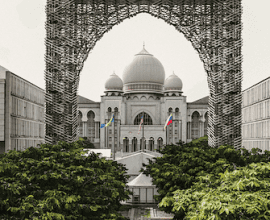

Would a new Menteri Besar, or a fresh election, end the Negeri Sembilan crisis? [16/NS]
Everyone has suggested a cure. “Change the Menteri Besar”. “Go back to the people”. But there are three problems, not one, and not one solution will be the key unlocks the problem that matters most.
HOW MANY DISPUTES ARE THERE, AND WHICH SOLUTION FITS WHICH?
Since 20 September, one cure has been offered from every side.
Change the Menteri Besar.
Or go back to the people.
Both sound simple. Both are keys.
The plainer question is this: “How many locks are there, and which key fits which?”
By ‘locks’ I mean disputes. By ‘keys’ I mean solutions.
On the text of the Constitution, there are three locks.
One key fits one of them well.
Neither fits the other two.
HOW THE THREE ‘LOCKS’ CAME TO BE
It begins on 19 April.
A proclamation issued in the name of the Undang Yang Empat, the four ruling chiefs, ‘declared’ the Ruler, the Yang di-Pertuan Besar, ‘removed’.1The proclamation of 19 April 2026 has been widely reported and its text transcribed by others.
Its validity is disputed.
The government of the day rejected it. An election followed on 1 August.
A new Menteri Besar was sworn in before Tuanku Muhriz the next day.
On 3 August, the Undang say, the new Menteri Besar, Ismail Lasim, signed the proclamation too. In September he said he had signed it under duress.
Neither claim has been tested.2The 3 August signature is asserted in a statement of 19 September 2026 issued by counsel for the Undang Yang Empat and the rival claimant, and in press reports. The Menteri Besar’s duress claim and police report were reported on 8 and 9 September 2026.
On 15 September the new MB’s Executive Council resolved to ‘accept’ the proclamation, and ordered it ‘gazetted’.
The State Secretary declined. The Attorney-General’s Chambers said the Exco’s announcement had no legal effect.3The Exco resolution of 15 September is recorded in the counsel’s statement of 19 September; the Menteri Besar announced it on 17 September. The State Secretary’s refusal and the AGC statement were both reported on 17 September 2026 (Malaysiakini; FMT). The original texts have not been seen.
On 20 September the palace revoked the appointment of all ten Exco members.
The Menteri Besar replied that they ‘remained in office’.4Istana Besar Seri Menanti statement of 20 September 2026, citing Articles XXXVIII(5) and XXXVIII(2), as reported by Malay Mail and Bernama; Menteri Besar’s reply reported 21 September 2026 (FMT; Malay Mail).
That is the chain.
Each link hangs on the one before.
And it has produced three locks.
The first lock lies between the Ruler and his government.
The second, between the Ruler and those who issued the April proclamation.
The third, inside the Assembly, over who leads at all.
Earlier essays dealt with the pieces: 9/NS, 12/NS, 13/NS and 15/NS.
“This one asks: “What would a change at the top actually change?”
THE FIRST LOCK: THE RULER AND HIS GOVERNMENT
What does the Constitution say about the Gazette?
Two documents are in play here, and they are often confused: the April proclamation, which the State Secretary would not gazette, and the palace’s revocation of the Exco.
Article X of the Constitution of Negeri Sembilan governs the removal of a Ruler by the Undang. It requires a “full and complete enquiry”, and it lists the grounds.
Then it says a proclamation, “shall be issued under the hands of the Undangs and the Menteri Besar”.5Laws of the Constitution of Negeri Sembilan 1959, Art X(1)–(2), 2003 and 2008 Reprints.
It says nothing about the Gazette. Article IX, on voluntary abdication, does: the Instrument “shall be published in the Gazette”.6Ibid., Art IX(4).
The reader may draw his own inference. This essay draws none; Essay 12/NS set out the argument.
The word “pleasure”
Article XXXVIII(5) says that Exco members other than the Menteri Besar hold office “at the Ruler’s pleasure”, unless their appointment is “revoked by the Ruler on the advice of the Menteri Besar”.7Ibid., Art XXXVIII(5), inserted by Enactment No. 9 of 1963.
Two readings exist.
On one, the Ruler may dismiss at will, and also on advice.
On the other, advice is the only door.
In 1966 a judge in Sarawak read a twin clause the first way: the Governor “may dismiss Ministers”.8Stephen Kalong Ningkan v Tun Abang Haji Openg and Tawi Sli [1966] 2 MLJ 187 (Harley Ag CJ), on Art 7(3) of the Sarawak Constitution. 13/NS lays out both sides.
Two oaths
Every Exco member has sworn two oaths.
As an Assembly member, to “preserve, protect and defend the Constitution”.
As a councillor, to give counsel freely and keep the Council’s business secret.9Ibid., Schedule, Part I (Art XXXIX) and Part II (Art LVIII). The palace statement spoke of a breach of oath. It did not say which.
What a new Menteri Besar would change here
A great deal.
A new Menteri Besar could withdraw the endorsement and put a fresh list before the Ruler under Article XXXVIII(2).
The Gazette standoff would end; no one would be asking for it.
The first key fits the first lock.
THE SECOND LOCK: THE UNDANG AND THE THRONE
This lock has two layers, and the difference matters.
The layer in court
The first layer is the Undang of Sungei Ujong.
The Dewan Keadilan dan Undang, the council of the Ruler and the ruling chiefs, dismissed him on 17 April.
He and five others sued in May for the minutes of that meeting and a stay of its result.10Seremban High Court Originating Summons NA-24NCvC-240-05/2026, filed 5 May 2026. The Yang di-Pertuan Besar and the Menteri Besar are not parties. On 19 October the Court of Appeal will hear whether the courts may look at it at all.
This essay describes that case. It says nothing about its merits.
The layer not in court
The second layer is the April proclamation itself.
On the public record, no court has been asked to rule on it.
The Dewan ruled on 14 September that Tuanku Muhriz remains Ruler.
The Attorney-General’s Chambers said the same three days later.11DKU ruling reported 14 and 17 September 2026 (Malay Mail; Bernama); AGC statement of 17 September 2026 (Malaysiakini).
Those who signed the proclamation say both are wrong.
Who decides
The Constitution gives this question to the Undang and the Dewan, under Articles X, XI and XVI.
Article 71 of the Federal Constitution says a dispute over the succession “shall be determined solely by such authorities and in such manner as may be provided by the Constitution of that State”.12Federal Constitution, Art 71(1).
The courts have said, more than once, that who is an Undang is for the Dewan.13Dato Menteri Othman bin Baginda v Dato Ombi Syed Alwi bin Syed Idrus [1981] 1 MLJ 29 (FC); Dato’ Shahari Hassan v Shamsudin Talib [1998] 3 MLJ 705 (CA).
What a new Menteri Besar would change here
Nothing in law.
He could change what the government says about the proclamation.
He cannot change whether it was valid, or who the lawful Undang are.
A fresh election changes even less.
Voters choose an Assembly.
They do not choose an Undang, and they have no vote on the throne.
The second lock takes neither key.
THE THIRD LOCK: THE ASSEMBLY, AND WHO LETS THE NEXT MAN IN
The numbers are not the problem
The coalition holds 25 of the 36 seats.14Election Commission results for the state election of 1 August 2026, as reported; official figures not checked this session. So the question is how a Menteri Besar could lawfully leave, and who chooses the next.
Four doors out of the office
He may resign.
Article XXXVIII(4) assumes it, and Article XL(2)(a) supplies the successor. In practice the lever is his own party.
He may lose the confidence of the House outside the House.
In Perak in 2009 the Federal Court held that loss of confidence may be shown by properly established evidence.
A Menteri Besar who then refuses to resign is deemed to have vacated office.15Dato’ Seri Ir Hj Mohammad Nizar bin Jamaluddin v Dato’ Seri Dr Zambry bin Abdul Kadir [2010] 2 MLJ 285; [2010] 2 CLJ 925 (FC), on Perak Art XVI(6), the twin of NS Art XXXVIII(4). Sabah followed in 2018.16Tan Sri Musa Hj Aman v Tun Datuk Seri Panglima Hj Juhar Hj Mahiruddin [2019] 10 MLJ 329 (HC).
One rule has changed since Perak.
Since 2022, Article LIA empties the seat of a member who resigns from his party or ceases to belong to it.
It does not touch a member who stays in his party and withdraws support from the Menteri Besar.17Laws of the Constitution of Negeri Sembilan (Amendment) Enactment 2022 (Enactment A34), s. 4, inserting Art LIA; in force 17 October 2022 (N.S. P.U. 43/2022). Text read on CLJLaw.
That is what fourteen members did in April.
The MB may be voted out on the floor.
The Assembly sits on 16 October.
The Speaker says no motion of no confidence has been filed, and he will allow no emergency motion.18Speaker Awaludin Said, reported 14 September 2026 (Malay Mail; Utusan Malaysia).
Article 72(1) of the Federal Constitution says the validity of proceedings in a State Assembly “shall not be questioned in any court”.
But the Federal Court has held that this shield covers only what an Assembly may lawfully do. In 2009 it reviewed the Perak Speaker’s suspension of Zambry and his Exco.
The Speaker had no such power, so the shield did not apply.19YAB Dato’ Dr Zambry Abd Kadir & Ors v YB Sivakumar Varatharaju Naidu [2009] 4 CLJ 253 (FC); Dewan Undangan Negeri Selangor v Mohd Hafarizam Harun [2016] 7 CLJ 143 (FC): “The Assembly must act within its constitutional and legal powers before the protection provided for under art. 72(1) of the Federal Constitution can arise.” Contrast Teng Chang Khim v Badrul Hisham Abdullah [2017] 9 CLJ 630 (FC), where a Speaker acting within an express power was held beyond review.
Whether a refusal to admit a properly noticed motion is inside the shield has never been decided.
The fourth door: the palace
Some will say there is a fourth door: the Ruler may dismiss the MB.
They will point to Article LXXIX, which preserves the prerogatives of His Highness and the ruling chiefs “except as expressed herein”, and to Article 181 of the Federal Constitution.20Laws of the Constitution of Negeri Sembilan 1959, Art LXXIX; Federal Constitution, Art 181(1) (“Subject to the provisions of this Constitution …”).
They will point to Sydney in 1932, where a Governor dismissed a Premier who was openly breaking a law the High Court had upheld.21Governor Sir Philip Game dismissed Premier J.T. Lang on 13 May 1932. See Anne Twomey, “The Unrecognised Reserve Powers”, High Court of Australia public lecture, 14 November 2012.
The text of the Constitution resists these arguments.
Article XXXVIII(5) puts every Exco member at the Ruler’s pleasure except one: the Menteri Besar. Article XL(1A) says the Ruler “shall accept and act in accordance with” advice.
And in 1966, on a Sarawak clause built the same way, the court held that the Governor “may not dismiss the Chief Minister in any circumstances”.22Ningkan, above.
The Sydney case turned on an illegality that was admitted and already decided by a court.
Here the legality is disputed and undecided.
Even Professor Twomey, the leading authority, says the Sydney question “probably should have been decided by a court”.23Twomey, above.
The second key: a fresh election
The other key on offer is dissolution.
Article LVI(2) says the Ruler may dissolve the Assembly.
Article XL(1A) says he acts on advice.
The only discretion the Constitution gives him is to refuse a request, under Article XL(2)(b).24Laws of the Constitution of Negeri Sembilan 1959, Arts LVI(2), XL(1A) and XL(2)(b); Federal Constitution, Eighth Schedule, Part I, s. 1.
So the road to a fresh election runs through a request, from this Menteri Besar or the next.
Is there a power to dissolve without any request, to break a deadlock?
A search of the Commonwealth found none.
Courts in Fiji and Samoa have struck such dissolutions down.25Qarase v Bainimarama [2009] FJCA 9, paras 94 and 166; FAST Party v Attorney General [2021] WSSC 24. India’s Supreme Court holds that a Chief Minister with a majority binds the Governor on dissolution: Nabam Rebia v Deputy Speaker (2016) 8 SCC 1, adopting the Punchhi Commission, para 4.5.04.
And a fresh election was held eight weeks ago.
In June the Assembly was dissolved at the then Menteri Besar’s request, with Tuanku Muhriz’s consent.
The Undang objected that a dissolution needed their concurrence too.26Reported joint statement of the Undang Yang Empat and the Tunku Besar Tampin, June 2026; the point rests on Art XXVIII(1), under which “Ruler” in the Second Part means His Highness and the Ruling Chiefs. Never ruled on.
It has never been answered.
A second dissolution would meet it again.
THE LOCK BEHIND THE LOCK
Here everything turns.
Appointing a Menteri Besar, and refusing a dissolution, are the two discretions in Article XL(2).
And Article XXVIII(2) says that for those two discretions “the Ruler” means His Highness “and at least three of the four Undangs”.27Laws of the Constitution of Negeri Sembilan 1959, Art XXVIII(2). The proviso allowing His Highness to act alone covers only paragraphs (f) and (g) of Art XL(2). See also Federal Constitution, Art 160(2), definition of “Ruler” for Negeri Sembilan.
Who the four Undang lawfully are is exactly what the second lock disputes.
So the third lock cannot fully turn until the second has.
Whoever the next Menteri Besar is, three Undang must join in choosing him. And the State is at odds over which three.
SO, WOULD IT END THE CRISIS?
A new Menteri Besar would open the first lock.
A government that recognises the Ruler who appointed it has no quarrel with him over gazettes and oaths.
A new MB would not open the second.
The proclamation’s validity, and the identity of the Undang, are not his to decide.
And the third lock, the one that chooses him, is itself held partly shut by the second.
A fresh election fares worse.
On its own it opens none of the three.
It needs a request the Ruler may lawfully refuse. And it walks back into the June objection.
The honest answer is this.
Either key would ease the crisis.
Neither would end it.
Those who promise more should say which lock they mean.
THE DOORS THE CONSTITUTION LEAVES OPEN
What of the reader who wants a way out, not only a diagnosis?
The Constitution names several doors.
This essay lists them and chooses none.
The floor of the House
The Assembly sits on 16 October, and the Yang di-Pertuan Besar is to open it.
Every Westminster constitution treats the floor of the House as the place where confidence is tested.28S.R. Bommai v Union of India (1994) 3 SCC 1; Nabam Rebia, above.
The Dewan Keadilan dan Undang
The Dewan is the body named to settle who is an Undang.
Its advice on such matters is said to be final under Article XVI(3).29Laws of the Constitution of Negeri Sembilan 1959, Art XVI(3), inserted by W.K.N.S. 546/1982.
Whether a court may look behind it is the very question fixed for 19 October.
A reference to the Federal Court
Article XXXIV(3) lets the Ruler refer “any question as to the effect of any provision of this Constitution” to the highest court for its opinion.30Ibid., Art XXXIV(3). The Article speaks of the “Supreme Court”, the name the Federal Court bore before 1994. Under Art XXVIII(1) “the Ruler” here means His Highness and the Ruling Chiefs; whether and how the power could be exercised while the Ruling Chiefs are themselves in dispute is an open question.
Article 130 of the Federal Constitution gives the Yang di-Pertuan Agong a similar power.31Federal Constitution, Art 130. Neither has been used. Either would put the questions where argument, not proclamation, decides them.
The Conference of Rulers
It exists.
Some lawyers urge a ‘special sitting’; others, a tribunal formed through it.32Proposals attributed in the press to Prof Abdul Aziz Bari and to Haniff Khatri Abdulla, 22–23 September 2026 (FMT; Newswav). Reported, not endorsed.
The Constitution stipulates nor requires either.
It forbids neither.
BOTTOM LINE
Two keys are on offer.
There are three locks.
One key fits one lock.
The others turn only in the hands the Constitution names: the Undang, the Dewan, and the courts.
Change the man at the top, if the Assembly and the Constitution allow it.
But do not expect every door to swing open.
∞§∞
This article is for general information only and is not legal or technical advice. Seek independent legal advice where appropriate.
Thanks to KN Geetha, TP Vaani, JN Lheela and Lydia Jaynthi of GK Legal, and Silas Kohler of Unsplash for the image. Claude (Anthropic) assisted with drafting and Perplexity Pro with fact-checking; the author is solely responsible for all views and errors.
© GK Ganesan Kasinathan. All rights reserved. No part of this site’s content may be used without prior written permission: gk@gkganesan.com.