What is a working arm worth? Orthoses, prostheses, and the price of restoring a brachial plexus
A brachial plexus injury costs an arm — and the law makes the insurer pay.
This essay discusses the development of the law on the award of orthoses and prostheses for brachial plexus injury, and the principles by which the courts measure them.
Ask a court what an arm is worth and it will, very properly, decline to answer. The question has no answer. An arm is not a commodity; it has no market; nobody sells one. And yet the law, being practical to the point of bluntness, writes a cheque anyway. What follows is how the common-law courts came to write that cheque — and why its size, the one thing the paying party most wishes to discuss, is so often the least interesting thing in the case.
FIRST PRINCIPLES
The fountainhead is Livingstone v Rawyards Coal Co, where Lord Blackburn described the measure of damages as the sum that will put the injured party in the position he would have occupied but for the wrong, so far as money can do it.1Livingstone v Rawyards Coal Co (1880) 5 App Cas 25, 39 (Lord Blackburn). Read that last clause again. So far as money can do it. It is a confession of failure dressed as a rule. Money cannot regrow a nerve. It cannot return to a teenager the hand she had a year ago. All it can do is fund the nearest substitute the age has managed to build. The House of Lords confirmed the full-compensation corollary in Lim Poh Choo v Camden and Islington Area Health Authority: the scale of the future cost is no reason to flinch from it.2Lim Poh Choo v Camden and Islington Area Health Authority[1980] AC 174 (HL).
THE INJURY, AND THE DEVICE
The brachial plexus is the cabling that runs from the spinal cord through the shoulder to the fingertips. Sever it and the arm becomes a passenger: present, useless, and — one imagines — resentful. The consequences the courts have recognised are not modest. In one Malaysian case the victim of a total brachial plexus injury was left unable to bathe, toilet or dress himself, the arm paralysed and the impairment permanent on the agreed medical evidence.3Mohd Sidik bin Muhamad Ketar v Zainal Hazril bin Zainal Mokhtar & Anor [2022] MLJU 1186 (High Court, Taiping; Muniandy Kannyappan J), at [2], [32]–[33].
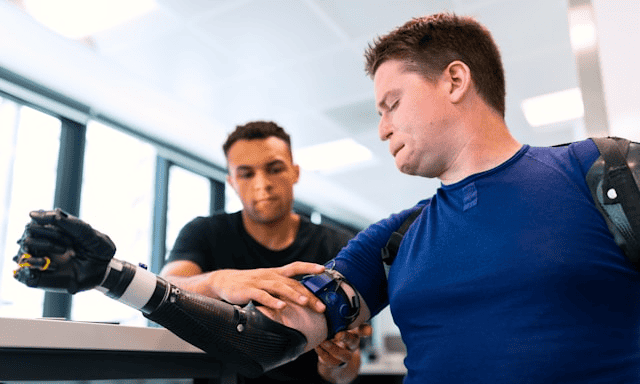
A myoelectric orthosis — the MyoPro being the current exemplar — reads the faint electrical signals still issuing from the surviving muscle and converts them into movement. It is expensive. So, it bears remembering, is a working arm.
“BEST” AND “REASONABLE”: TWO WORDS, ONE DESTINATION
The Commonwealth’s instinct. The leading Malaysian statement is Appalasamy Bodoyah v Lee Mon Seng, where the Court of Appeal held the victim entitled to the best medical facility and the best medical opinion — not merely the cheapest option that would serve.4Appalasamy a/l Bodoyah v Lee Mon Seng [1996] 3 CLJ 71, 77–80 (Abdul Malik Ishak J). The defendant there ran what one might call the patriotic defence: that the plaintiff should “Buy Malaysia” and take a cheaper locally-made limb rather than the Singapore electronic arm his own specialist recommended. The court was unmoved, and awarded the cost of the electronic arm together with its periodic renewals.5Appalasamy, above: the court rejected the submission that the plaintiff should be confined to the cheaper local quotation and awarded S$132,000 for the electronic artificial arm and servicing. Thrift urged on the victim by the party who injured him has a way of sounding less noble than it thinks.
The same instinct, an older pedigree. Appalasamy did not invent the principle; it inherited it. The Malaysian courts had been allowing the cost of artificial limbs, their renewals, and the cost of a spare, for decades. As long ago as 1973, in Yeap Cheng Hock v Kajima-Taisei Joint Venture, the court allowed the cost of replacing the limb from time to time and the cost of an additional artificial limb.6Yeap Cheng Hock v Kajima-Taisei Joint Venture [1973] 1 MLJ 230, as recited and applied in Appalasamy [1996] 3 CLJ 71. The same generosity runs through R J McGuinness v Ahmad Zaini and Lee Boon Kiat v Ng Sing,7R J McGuinness v Ahmad Zaini [1980] 2 MLJ 304; Lee Boon Kiat v Ng Sing [1982] 1 MLJ 229, 232 — both cited with approval in Appalasamy [1996] 3 CLJ 71. and through Mohd Eusoff Chin J’s awards in Wong Yee Cheong v Toh Seng Chuan (the limb plus renewals of replacement parts) and Azman bin Kasri v Md Isa bin Endut (the fitting of the limb, future renewals of consumptive items, and even the travel to have it serviced).8Wong Yee Cheong & Anor v Toh Seng Chuan [1988] 2 CLJ Rep 555; Azman bin Kasri & Anor v Md Isa bin Endut & Govt of Malaysia[1988] 2 CLJ 743 (cost of fitting RM33,600; renewal of consumptive items RM20,640; servicing travel RM10,500). Both reviewed in Appalasamy [1996] 3 CLJ 71. The principle was settled long before the technology arrived to test it: a restorative device is an instrument of restitutio, not an indulgence. The outward form has changed from wood and steel to motors and electrodes; the legal principle has not.
The English temper. The English courts, congenitally suspicious of the word “best”, ask instead what is reasonably required. The difference is real but, in the end, verbal. In Sowden v Lodge the Court of Appeal framed the test as the regime reasonably required in accordance with the compensatory principle.9Sowden v Lodge [2004] EWCA Civ 1370; [2005] 1 WLR 2129 (CA). In Whiten v St George’s Healthcare NHS Trust the test was applied to an award of some £6.6 million, the court insisting only that each item be justified by reasonable need rather than mere aspiration, with proportionality weighed between the cost of an item and the benefit it confers.10Whiten v St George’s Healthcare NHS Trust [2011] EWHC 2066 (QB) (Swift J). For a catastrophic and permanent loss, the reasonable need and the best available device tend to be the same object viewed from different benches. “Best” without reason is extravagance; “reasonable” without ambition is meanness. The authorities, sensibly, decline both.
USEFULNESS, NOT COST: MOHD SIDIK
The modern Malaysian authority of first importance is Mohd Sidik bin Muhamad Ketar v Zainal Hazril bin Zainal Mokhtar & Anor.11Mohd Sidik bin Muhamad Ketar v Zainal Hazril bin Zainal Mokhtar & Anor [2022] MLJU 1186 (High Court, Taiping; Muniandy Kannyappan J), Civil Appeal No AB-12BNCVC-2-01 of 2020, decided 15 June 2022 — an appeal from the Kuala Kangsar Sessions Court. A motorcyclist suffered a total brachial plexus injury and lost the use of his right arm. His orthotist’s quotations had climbed from RM109,000, to a supplementary RM111,000, and at last — once the brachial plexus injury was identified — to a MyoPro motorised orthosis with twelve years of battery replacement, totalling RM3,977,160.12Mohd Sidik, above, at [8] (the three quotations and their escalation following identification of the brachial plexus injury).
The Sessions Court had refused the device for the very reason insurers always give: that it cost a great deal and would over-enrich the plaintiff. Muniandy J held that to be the wrong test. The plaintiff was entitled to the best, the purpose of compensation being to restore him as nearly as possible to the position he occupied before the tort.13Mohd Sidik, above, at [31] (reproducing the appellate reasoning that the Sessions Court had erred in treating the size of the sum and “unjust enrichment” as the dominant consideration). The pivotal question, he said, was the use and usefulness of the orthosis on the medical evidence, and never the cost of the equipment.14Mohd Sidik, above, at [42]: “The pivotal issue is the use and usefulness of an orthosis arm for him premised on medical evidence available on record, and never the costs of the orthosis equipment.”
Two further points earn their keep. First, the insurer’s complaint that the recommendation was a late “afterthought”, the final figure many times the first, was rejected: a recommendation made with basis and cogent reasons, for a device that would be fully beneficial to the plaintiff permanently, is not impeached by having come late.15Mohd Sidik, above, at [41]. A diagnosis that sharpens with time is a reason for a larger figure, not a reason to suspect it; an early estimate is not a ceiling on damages. A late injury is sufficient explanation for a late, and larger, price. Secondly, the device was awarded with its lifelong battery replacement built in — the upkeep, not merely the first purchase.16Mohd Sidik, above, at [31], [42] (allowing the cost of the orthosis “and lifelong replacement attendant to it”).
The insurer appealed. The Court of Appeal dismissed the appeal with costs.17Court of Appeal order dated 25 May 2023 (Che Mohd Ruzima bin Ghazali, Mohd Nazlan bin Mohd Ghazali and Azman bin Abdullah JJCA): “Rayuan ditolak” (appeal dismissed), with costs of RM10,000 to the respondent/plaintiff subject to allocatur. The Court of Appeal delivered no written grounds, so that the High Court judgment of Muniandy J remains the only reasoned decision in the matter. A large award for a myoelectric orthosis, replacements and all, has therefore survived appellate scrutiny in Malaysia — even if, the appeal being dismissed without written grounds, the reasoning that survives is that of Muniandy J.
AWARDS ABROAD, AND THE OBJECTIONS THAT FAILED
If there is a fear that modern devices are simply too dear to contemplate, the authorities abroad are a useful corrective. In each, the very objection now pressed — that the device costs too much — was put, considered, and overruled.
Replacements are part of the need, not an extra. In State Rail Authority of New South Wales v Luckwell, the plaintiff lost his right arm at the shoulder after a fall beneath a train.18State Rail Authority of NSW v Luckwell [2000] NSWCA 223 (Priestley and Heydon JJA, Foster AJA), at [44]. Quantum fell to be assessed under the Motor Accidents Act 1988 (NSW), the trial judge assessing the loss of the dominant arm at 65% of a most extreme case. The trial judge allowed a myoelectric arm at A$30,000 with replacements every three years to the age of seventy-six.19Luckwell, above, at [49]–[50]. The defendant appealed, contending that only the first prosthesis should be funded. The Court of Appeal would have none of it, upholding the trial judge’s view that it was — “an absurd proposition to allow the Plaintiff only the initial cost of such an arm as he would have no prospects of purchasing replacements as they became necessary and his prospects of re-employment would be very greatly diminished if not entirely extinguished.20Luckwell, above, at [50]–[51], [56] (appeal dismissed with costs). The trial judge had also discounted the replacement sum for the contingency that the prosthesis might prove unsuccessful, while “keeping in mind the probability of future medical advancement in this area”.
A spare arm, and a reasonable cosmetic one. Hanlon v Hanlon Enterprises Pty Ltdrepays study for its detail rather than its size. A sixteen-year-old labourer lost his left hand to a grain auger; he was later fitted with a myoelectric prosthesis.21Hanlon v Hanlon Enterprises Pty Ltd & Anor [2004] NSWSC 930 (Hislop J), at [5], [90]–[93]. Hislop J allowed not one device but a working myoelectric prosthesis and a reserve, on the plain logic that a man cannot be left without an arm while the first is repaired.22Hanlon, above, at [136] (allowing maintenance for “one myoelectric prosthesis and a reserve or back up myoelectric prosthesis”), with three-yearly replacement at [142]. He preferred the costings of the prosthetist who had cared for the plaintiff throughout, holding it unreasonable to make an injured man change prosthetists or “shop around” for cheaper parts.23Hanlon, above, at [135]. And, over the defendant’s objection that it was “ideal” rather than reasonable, he allowed a A$34,000 silicone “living skin” glove, accepting that a young man embarrassed by his stump would wear and use the hand far more if it looked real.24Hanlon, above, at [144]: the court held the provision of “living skin” a reasonable requirement notwithstanding its disproportionate cost, because it would spare the plaintiff embarrassment, widen his activities and promote his self-esteem. The future prosthetic needs came to A$1,054,314, and the future out-of-pocket head that contains them to A$1,069,682.25Hanlon, above, at [147], [153]. The two figures are not cumulative: the A$1,069,682 future out-of-pocket head includes the A$1,054,314 prosthetic component. That is the reasonableness test doing real work, and answering the parsimony argument in terms.
The dearer arm, chosen. Canada met the cost objection head-on in Giannone v Weinberg. A six-year-old lost her dominant forearm after negligent treatment of a fracture; the contest at trial lay between the American “Utah Arm” she sought and a cheaper home-made alternative the defendant pressed.26Giannone v Weinberg (1989) 68 OR (2d) 76 (Ontario Court of Appeal). Leave to appeal to the Supreme Court of Canada was refused. The Ontario Court of Appeal preserved the award of the more expensive arm, on the simple ground that the plaintiff was entitled to the best prosthetic devices available from time to time — and upheld with it a reserve arm and a yearly maintenance allowance.27Giannone, above: the Court of Appeal preferred the Utah Arm as best suited to the plaintiff, and upheld provision for replacement, a back-up arm and annual maintenance. Across three jurisdictions the refrain is the same: suitability governs, and thrift, however earnestly urged by the paying party, does not.
WHEN EXPERTS COLLIDE
The familiar endgame is a duel of experts, the defendant’s man producing a cheaper device and a thinner report. The Federal Court in Tan Sri Khoo Teck Puat v Plenitude Holdings Sdn Bhdforbade the lazy compromise of splitting the difference: faced with a conflict of expert testimony, the judge must analyse the reasoning of the rival experts and accept one over the other, not average the two.28Tan Sri Khoo Teck Puat & Anor v Plenitude Holdings Sdn Bhd [1994] 3 MLJ 779, 797 (Federal Court). An expert who shows that the device is tailored to the claimant’s deficits, and explains why it restores function, will generally see off one whose ambition rises no higher than maintaining the claimant in his incapacity.
THE STATUTE THAT ENDS THE ARGUMENT
In a third-party motor claim there is a further answer to the plea of expense, and it is statutory.
The Road Transport Act 1987 is social legislation, and reads like it. Section 91(3) fixes the insurer with liability to indemnify “notwithstanding anything in any written law”; section 96(1) requires it, after judgment, to pay “any sum” payable in respect of the liability.29Road Transport Act 1987 (Act 333), ss 91(3) and 96(1). The operative phrases are “any liability” and “any sum”. Any liability. Any sum. These are not timid expressions. Section 94 completes the work by striking down any policy condition that purports to cut down third-party liability after the event.30Road Transport Act 1987, s 94 (conditions in policies to be of no effect).
The Federal Court put the purpose beyond argument in AmGeneral Insurance Bhd v Sa’Amran Atan, holding that compulsory motor insurance exists to give innocent third parties full and effective protection regardless of the private arrangement between insurer and insured, and that reliance on an exclusion clause to defeat the third party is an attempt to contract out of the statute, which section 94 forbids.31AmGeneral Insurance Bhd v Sa’Amran Atan & Ors and other appeals [2022] 8 CLJ 175 (Federal Court, per Abdul Rahman Sebli FCJ), holding inter alia that reliance on an exclusion of liability clause is “an attempt to contravene the statute, which is prohibited by s 94” and approving the protective purpose of compulsory third-party insurance. The size of the award is, in this scheme, the insurer’s misfortune, not its defence.
The American outlier. Insurers are fond of M.M. v United Healthcare Insurance Co, in which a MyoPro was refused as “unproven and not medically necessary”.32M.M. v United Healthcare Insurance Co (Appellate Court of Maryland, No 2039, Sept Term 2019; Circuit Court for Baltimore City Case No 24-C-19-002438), Woodward J, filed 5 January2023. The case is, with respect, distinguishable on every limb, and furnishes no precedent even in its own jurisdiction — being an unreported opinion that the Maryland courts are expressly forbidden to cite.33The opinion bears the rubric: “This is an unreported opinion, and it may not be cited in any paper, brief, motion, or other document filed in this Court or any other Maryland Court as either precedent within the rule of stare decisis or as persuasive authority. Md. Rule 1-104.” It was a judicial review of an insurance Commissioner’s decision, and it rested not on any principle of tort but on a private health plan’s express exclusion of “Experimental Services” and “unproven” devices.34M.M., above: coverage was denied because the device fell within the plan’s “Experimental Services” exclusion and appeared on the insurer’s omnibus list of “unproven” services; the proceeding was judicial review under the Maryland Insurance Article. An exclusion of that kind would find no traction in Malaysia, where s 91(3) imposes liability “notwithstanding anything in any written law” and s 94 voids any condition purporting to defeat a third party’s claim. That an insurer may shelter behind its own exclusion clause says nothing of a tortfeasor who has none.
A NOTE ON OVERLAPPING
Defendants reliably plead the “age-old principle of overlapping” to shave a percentage from every head. It is not mandatory: where injuries affect different parts and functions of the body, separate awards are proper, and only injuries to the same part or function carry a real risk of double-counting.35Seah Yit Chen v Singapore Bus Service (1978) Ltd & Ors [1990] 1 LNS 56; [1990] 3 MLJ 144; cf Chong Chee Khong & Anor v Ng Yeow Hin [1997] 1 MLRH 822. The device stands in a category of its own and is not to be discounted as though it were a bruise.
THE PRINCIPLES, DISTILLED
These propositions are written to be lifted off the page and carried into any Commonwealth court. Each is self-contained, anchored to authority, and framed as a rule an advocate can put to a judge without adaptation.
The set is portable enough for any court in the Commonwealth to lift off whole and carry home. An advocate in Kuala Lumpur, Singapore, Sydney, Toronto or London need invent nothing. He need only show the device is medically needed and well-suited, prove its cost and its replacements, and invite the court to do what the common law has done since Livingstone: measure the loss, and decline to haggle over the price of putting it right.
The instinct of the law, in the end, is a generous one, and properly so.
It cannot give the victim her arm back; the least it can do is buy the nearest thing the market has built, and decline to haggle while it does.
∞§∞
This article is written for a general and professional readership and does not constitute technical or legal advice. Readers with legal questions are encouraged to seek independent legal advice.
The author thanks Mr UK Menon, Miss KN Geetha, Miss TP Vaani, Miss JN Lheela, and Miss Lydia Jaynthi. We thank thisisengineering of Unsplash, for the image.
Claude, Anthropic’s AI, smoothed the drafting; Perplexity Pro checked the facts. The argument, the views, and the errors remain the author’s.
@Copyright reserved.
All content on this site, including but not limited to text, compilation, graphics, documents, and layouts, is the intellectual property of GK Ganesan Kasinathan and is protected by local and international copyright laws. Any use shall be invalid unless written permission is obtained by writing to gk@gkganesan.com.