What Do You Do When Your Own Judgment Rules Against You? (Salleh Abas LP)
He declared Malaysia’s law secular, then spent the rest of his life obeying his own judgment — in pencil. Why the pencil, do you think?
What happened on 29 February 1988?
On that day, the Lord President of Malaysia delivered judgment in Che Omar bin Che Soh v Public Prosecutor.1Che Omar bin Che Soh v Public Prosecutor [1988] 2 MLJ 55 (Supreme Court, Kuala Lumpur). Salleh Abas LP delivered the grounds of a unanimous five-member court. This blog has examined the case’s constitutional afterlife in “Do Malaysian non-Muslims have the fundamental right to worship?”: https://www.gkg.legal/do-non-muslims-have-the-fundamental-right-to-worship/.
Three men stood condemned to death for drug trafficking.
Their counsel made a bold argument. Islam is the religion of the Federation, says Article 3 of the Constitution. Therefore, they said, every law of Malaysia must answer to Islamic law — and this one failed.
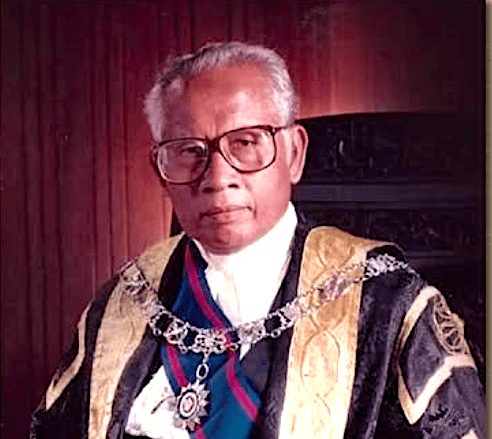
The judge who heard them was Tun Mohamed Salleh bin Abas.
He was, by every account, the most devout Muslim man ever to hold the office.
He rejected the argument.
The law of Malaysia, he held, is secular law.
To understand why that holding is astonishing, you must first understand the man.
The Boy from Besut, Terengganu
He was born in Kampung Raja, Besut, Terengganu, in 1929, the son of a sailor and small village trader.2Tunku Abdul Rahman’s foreword to Salleh Abas and K Das, May Day for Justice (Magnus Books, 1989), quoted in the speech of the President of the Malaysian Bar at the Reference Proceeding for Tun Salleh Abas, Palace of Justice, 14 September 2022: https://www.malaysianbar.org.my/article/news/speeches/speeches/speech-by-karen-cheah-yee-lynn-president-of-the-malaysian-bar-at-the-reference-proceeding-for-tun-dato-dr-mohamed-salleh-bin-abas-on-14-september-2022-palace-of-justice-.
During the Japanese occupation, he studied at the village madrasah — a school that had opened in 1942, by the river, with one teacher and sixteen boys.3The school’s own history records him among its wartime pupils: Sekolah Menengah Agama Maarif, Kampung Raja, Besut, founded 1942 as Madrasah Rokki al-Arif; history reproduced at https://smatmas.blogspot.com/p/sma-maarif_5201.html.
He learned his religion in Malay, written in Jawi
To the end of his life he read Jawi more fluently than romanised script. His friend of later years, the Terengganu religious scholar Abdul Hadi Awang, remembered his beautiful Jawi hand.4Abdul Hadi Awang, “Tun Salleh Abas dalam kenangan”, Harakahdaily, 17 January 2021: https://harakahdaily.net/2021/01/17/tun-salleh-abas-dalam-kenangan/.
To Aberystwyth, the Middle Temple, then home to the AGC
From that riverside school he went, in 1949, to Britain. A law degree at Aberystwyth. The English Bar, at the Middle Temple, in 1955. A master’s in London.5Biographical details from the as-Salihin Trustee Berhad biography, https://as-salihin.com/almarhum-tun-dato-dr-haji-mohd-salleh-abas/, and from his own account in Arfa’eza A Aziz, “Former Lord President did it his way, too”, Malaysiakini, 1 July 2002: https://www.malaysiakini.com/opinions/21642.
Burning the candle at both ends
Then thirteen years in the Attorney-General’s Chambers, rising to Solicitor-General.
A colleague from those years remembered him in the Chambers library past midnight, doing his own research beside the chief librarian.6Muhammad Shafee Abdullah, “A short memoir of Salleh Abas”, Malay Mail, 16 January 2021: https://www.malaymail.com/news/what-you-think/2021/01/16/a-short-memoir-of-salleh-abas-muhammad-shafee-abdullah/1941012.
When the 1969 emergency came, he did not go home. He stayed in the office for a week, drafting the emergency laws, while police officers brought him food.7His own account, Malaysiakini, 1 July 2002, above.
Rukun Negara – who drafted it, you think?
And when the nation needed a creed, he drafted that too. “The actual writing and drafting was done by me,” he said of the Rukun Negara, in his last recorded interview, six days before his ninety-first birthday.8“Rukun Negara not plucked from the air, says Salleh Abas”, Bernama, 19 August 2020, in Malay Mail: https://www.malaymail.com/news/malaysia/2020/08/19/rukun-negara-not-plucked-from-the-air-says-salleh-abas/1895190.
Tun Suffian’s role in his life
Tun Suffian persuaded him onto the Federal Court bench around his fiftieth birthday.
Suffian is a name worth pausing over.
He wrote the plainest, kindest English ever to come out of a Malaysian court.
And he ran a whole judiciary on it.
Law students, read him slowly. He will deepen your understanding. That was his intent, anyway.
By February 1984, Salleh Abas was Lord President.
The Judgment
Now return to that leap-year morning in 1988.
Here is what most commentators miss.
Before he decided anything, Salleh Abas set out, with evident feeling, what Islam truly is.
Not “a mere collection of dogmas and rituals,” he wrote, but “a complete way of life covering all fields of human activities” — private and public, legal, political, economic, social, moral.9Che Omar, above, at 56.
That is not the language of a man reaching for a technicality.
That is a believer, stating his belief from the highest bench in the land.
And then he did the harder thing
He traced the constitutional history honestly. He showed how colonial rule had confined Islamic law to marriage, divorce and inheritance. He held that the framers of the Constitution, in Article 3, had used “Islam” in that confined sense.
“We have to set aside our personal feelings,” he wrote, “because the law in this country is still what it is today, secular law.”10Che Omar, above, at 56–57.
Read that sentence again. Our personal feelings.
He was telling you, in open court, that his own heart argued the other side.
Most judgments are walls
They stand between a litigant and the thing he wants, and there is nothing to be done but turn back.
This one was different. In its final breath, the Lord President built a door, and pointed through it.
“Perhaps that argument should be addressed at other forums or at seminars and, perhaps, to politicians and Parliament. Until the law and the system is changed, we have no choice but to proceed as we are doing today.”11Che Omar, above, at 57.
Hold that door in your mind. We shall come back to it.
The Bulwark – Being asked to commit a sitting Prime Minister
A year before Che Omar, he had been asked to do something no Malaysian judge had been asked to do before.
The Leader of the Opposition applied to commit the Prime Minister for contempt of court.
Dr Mahathir Mohamad had told Time magazine that if a court kept interpreting laws contrary to the government’s intent, “we will have to find a way of producing a law that will have to be interpreted according to our wish.”12The interview was published in Time in late 1986; the contempt application it provoked was dismissed by Harun Hashim J in the High Court and, on appeal, by the Supreme Court in Lim Kit Siang v Dato’ Seri Dr Mahathir Mohamad [1987] 1 MLJ 383.
Punish him, said the application.
The Lord President declined.
Criticism of the courts — even a Prime Minister’s exasperation with them — was not contempt. The law said so, and the law protected the critic.
But in the very judgment that shielded the Prime Minister, he set down the sentence Malaysian courts still quote:
“The courts are the final arbiter between the individual and the State and between individuals inter se, and in performing their constitutional role, they must of necessity and strictly in accordance with the Constitution and the law be the ultimate bulwark against unconstitutional legislations or excesses in administrative action.”13Lim Kit Siang v Dato’ Seri Dr Mahathir Mohamad [1987] 1 MLJ 383 at 387.
Mark the shape of that.
Asked to punish his critic-in-chief, he protected him — because the law required it. And he used the same page to state, for the permanent record, what the courts are for.
He would not bend the law even to defend the courts themselves.
The Fall
Three months after Che Omar, the storm broke.
The events of 1988 — the suspension, the tribunal, the removal of the Lord President and two of his brethren — have been told elsewhere on this blog, and I will not retell them here.14See “What Happened During the Malaysian Judicial Crisis in 1988?”, GK Legal: https://www.gkg.legal/what-happened-during-the-malaysias-1988-judicial-crisis/.
It is enough to say that he did not stand alone.
Raja Aziz Addruse appeared for him — the President of the Malaysian Bar itself, taking up the defence of the head of the judiciary. He remains the only man ever to lead the Bar three times.
And he never stopped saying, in measured print, what he had said before the tribunal: that the charges were “generally regarded as politically motivated and tenuous,” and that the tribunal’s composition “left grave doubts as to its independence and impartiality.”15Raja Aziz Addruse, “Judicial Appointments: Who Has The Last Say” (2002) XXXI(4) INSAF 43 at 44–45. Raja Aziz led Tun Salleh’s defence in 1988 while serving as President of the Malaysian Bar; he held that office three times — the only man ever to do so.
Law students: when you have finished with the judges in this series, read the advocate. Raja Aziz wrote the way he argued — quietly, and without a wasted word.
What matters for our purposes is what Tun Salleh called it.
The lion beneath the throne, ensnared
The next year he published a book in Malay on judicial independence. Its subtitle was his own coinage: Singa di Bawah Takhta Dijerat — the lion beneath the throne, snared.16Mohamed Salleh Abas, Kebebasan Kehakiman: Singa di Bawah Takhta Dijerat (Satu Kezaliman) (Penerbitan Pena, 1989): https://catalog.hathitrust.org/Record/001816363.
The image is older than Malaysia. It comes from Francis Bacon, Lord Chancellor of England, in his essay “Of Judicature”: judges should remember that Solomon’s throne was supported by lions on both sides — “let them be lions, but yet lions under the throne.”17Francis Bacon, “Of Judicature”, in The Essayes or Counsels, Civill and Morall (1625).
Bacon meant it as counsel of restraint. The lion serves the throne; he does not roar against it.
Salleh Abas added one Malay word, and turned four centuries of comfortable doctrine into an indictment. Dijerat. Snared.
What use is a lion under the throne, the subtitle asks, if the throne lets the hunters set their traps beneath it?
The Wilderness
He did not take the fall well. Why should he have?
“I became … an outcast,” he wrote twenty years later. The lecture invitations dried up. He gave up his examinerships.18Mohamed Salleh Abas, “Fifty Years of Constitutional Government in Malaysia”, Ahmad Ibrahim Memorial Lecture 2008, (2009) 17 IIUMLJ 1: https://journals.iium.edu.my/iiumlj/index.php/iiumlj/article/download/28/27/108.
“That is why I feel very, very bitter about the dismissal,” he said in 2002.19Malaysiakini, 1 July 2002, above.
The lawyer and writer Salleh Buang went to see him soon after the sacking, to give — as he put it — the moral support of a son to a father. He found that Tun had not yet come back from the surau after Asar prayers, and waited outside.
Urged to keep writing, so that his learning would not be lost, the old judge answered that his mind was still belum tenang — not yet at peace.20Salleh Buang, “Tun Salleh yang saya kenal”, Utusan Malaysia, 19 January 2021: https://www.utusan.com.my/rencana/2021/01/tun-salleh-yang-saya-kenal/.
But peace came. And it came from exactly where you would expect.
“My strength is Allah,” he said. “I take it as God’s will. If my rezeki is not here then I can find it elsewhere. That’s all. I have to move on with what I have.”21Malaysiakini, 1 July 2002, above.
And then this, which no one who reads it forgets:
“I would rather lose everything except my principle.”22Malaysiakini, 1 July 2002, above.
The Door
Now watch what he did next. Watch it against the closing words of his own judgment.
Che Omar said: the courts cannot give you Islamic law.
Go to the politicians. Go to the legislature.
So he went.
PAS asked him to prepare the Syariah criminal enactments for Kelantan and Terengganu.
He prepared the drafts fully, in his own hand, and both state assemblies passed them.23Abdul Hadi Awang, Harakahdaily, 17 January 2021, above. Hadi, who led the drafting committee, records that Salleh Abas was entrusted with preparing the full draft of the enactments.
At Jertih – “His questions frightened me”
In 1999, at seventy, he stood for the Terengganu state assembly and won the seat of Jertih.24Election results for N.03 Jertih, Terengganu, 1999: https://electiondata.my/ms-MY/seats/dun/n03-jertih-terengganu/.
Every Friday he attended the dawn religious lecture at the Rusila mosque, then climbed to Hadi Awang’s sitting room to continue the discussion.
“His questions frightened me,” Hadi confessed, “because sometimes I had to go and consult the books first before I could answer.”25Abdul Hadi Awang, Harakahdaily, 17 January 2021, above.
A former Lord President of Malaysia, frightening the country’s most prominent religious scholar with his questions. In his seventies. Every Friday.
And here is the point on which this whole essay turns.
In 2002, sitting as a state executive councillor in a PAS government, he was asked about the state of the nation. Did he recant his great judgment? Did he soften it?
He restated it.
“At the moment, we live in a secular country. The Federal Constitution and the laws state clearly that we are living in a secular state.”26Arfa’eza A Aziz, “BN trapped itself with Islamic state declaration: Salleh Abas”, Malaysiakini, 2 July 2002: https://www.malaysiakini.com/news/12030.
Fourteen years after Che Omar.
Stripped of office, wearing party colours, with every worldly incentive to say the opposite — he held his own line.
The law is what it is.
If you want it changed, change it lawfully.
He never once, in any speech or interview that survives, revisited Che Omar by name.
He never explained himself.
He never seems to have felt there was anything to explain.
Because there was no contradiction.
The judge had said: not here — there
The believer walked out of the courtroom, through the door his own judgment had built, and spent his old age there: drafting, standing, persuading, submitting the whole question — as his judgment required — to the assemblies of the people.
Whatever one’s view of the laws he drafted, the method was perfect fidelity.
He is the rarest thing in public life: a man who lost everything to power, and still would not take the shortcut past his own reasoning.
The Pencil
Hadi Awang preserved one detail that is worth more than every honour the man ever received.
When Salleh Abas sat down to draft the Syariah enactments — the laws of God, as he understood them — he wrote in pencil. Why?
So that the words could be rubbed out, and corrected, in discussion.27Abdul Hadi Awang, Harakahdaily, 17 January 2021, above: “Almarhum Tun Salleh Abas menggunakan penselnya apabila ditugaskan menyusun ayat undang-undang supaya senang kalau perlu diperbetulkan dan diubah dalam perbincangan.”
Think about what that pencil says.
A pen asserts. Ink is confident; it expects to be final.
A pencil submits. It assumes, from the first stroke, that the writer may be wrong — and that others must be free to correct him.
And this was a man who had spent his whole working life in ink.
Emergency regulations.
The Rukun Negara.
Judgments of the Supreme Court. Instruments meant to be final.
Faced with the most solemn drafting of his life, he set the ink aside.
The ink of certainty for the state’s law. The pencil of humility before God’s.
The Acknowledgement
In April 2008, twenty years after his removal, a Prime Minister stood before the Malaysian Bar and acknowledged “the pain and loss” the six judges of 1988 had endured, “although this acknowledgement is 20 years too late.”28Abdullah Ahmad Badawi, “Delivering Justice, Renewing Trust”, speech at the Malaysian Bar Council dinner, 17 April 2008: https://www.malaysianbar.org.my/article/news/press-statements/press-statements. The government made goodwill ex gratia payments; the sum of RM5 million to Tun Salleh was disclosed in the Dewan Rakyat on 6 November 2008: https://www.malaysianbar.org.my/article/news/bar-news/news/former-judges-got-rm10-5m-ex-gratia.
It was an acknowledgement, not an apology. The decisions of 1988 were expressly left unrevisited.
Later that year, a Panel of Eminent Persons — chaired by a former Chief Justice of India — reviewed the whole affair and concluded that the removal of Tun Salleh was unconstitutional and non est.
Not only was he innocent of the charges, the Panel found. He had been “performing his constitutional duty to uphold and protect the doctrine of separation of powers and the rule of law.”29Report of the Panel of Eminent Persons to Review the 1988 Judicial Crisis in Malaysia, launched 29 August 2008: https://www.malaysianbar.org.my/cms/upload_files/document/PanelofEminentPersonsReport.pdf.
Asked about it all in 2018, at eighty-eight, he waved the past away.
“I’m very tired of it. Life has gone on for me.”30Bede Hong, “Move on already, says Salleh Abas of 1988 judicial crisis”, The Malaysian Insight, 6 January 2018: https://www.themalaysianinsight.com/s/31052.
The Answer
He died in the early hours of 16 January 2021, in Kuala Terengganu, aged ninety-one.
Under the pandemic protocols of that grim season, he was buried the same morning by health workers in protective suits. His family stood at a distance.31“Former Lord President Tun Salleh Abas passes away aged 91”, The Star, 16 January 2021: https://www.thestar.com.my/news/nation/2021/01/16/former-lord-president-tun-salleh-abas-passes-away-aged-91.
In September 2022, the judiciary held a Reference Proceeding for him at the Palace of Justice — the institution’s final salute to the lion it had lost.32Reference Proceeding for Tun Dato’ Dr Mohamed Salleh bin Abas, Palace of Justice, 14 September 2022, above.
So — what do you do when your own judgment rules against you?
Most of us appeal. We distinguish. We quietly hope the point will not come up again.
Salleh Abas did none of these.
He obeyed.
For thirty-three years, without complaint and without contradiction, he obeyed his own judgment — and pursued what he believed through the one door it had left open.
In pencil. Ready to be corrected.
That is not the story of a paradox.
That is the story of an honest man.
∞§∞
This article is written for a general readership and does not constitute technical or legal advice. Readers with legal questions are encouraged to seek independent legal advice.
The author thanks KN Geetha, TP Vaani, JN Lheela, and Lydia Jaynthi at GK Legal. Our gratitude to the Malaysian Juciairy for the image.
Claude, Anthropic’s AI, smoothed the drafting; Perplexity Pro checked the facts. The argument, the views, and the errors remain the author’s.
@Copyright reserved.
All content on this site, including but not limited to text, compilation, graphics, documents, and layouts, is the intellectual property of GK Ganesan Kasinathan and is protected by local and international copyright laws. Any use shall be invalid unless written permission is obtained by writing to gk@gkganesan.com.