Tribunal One [Part 5/11-The Malaysian Judiciary Then and Now]
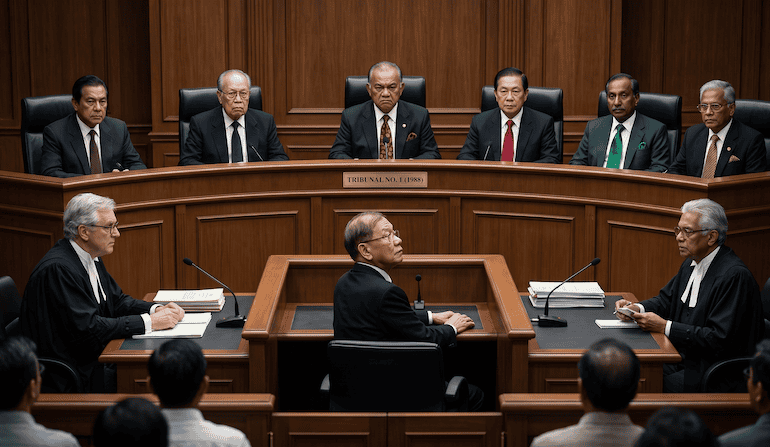
Six men were appointed to try the head of the Malaysian judiciary. One of them would get his job.
Chapter 5 of What the Judiciary Was and What It Has Become
[A record of the Malaysian Judiciary, before 1988 to now]
Six men were appointed to try the head of the Malaysian judiciary.
One of them would get his job.
The list of 11 June
Chapter 4 ended on 27 May 1988. Tun Salleh Abas had been suspended. A tribunal was to be appointed.
A tribunal, here, is not a court. It is a body of judges set up under Article 125(3) of the Federal Constitution. It looks into allegations against a judge and reports to the King. It cannot fine anybody or gaol anybody. It can only recommend. But when it recommends removal, a career is over.
On 11 June 1988 the Prime Minister sent the King six names.1Panel of Eminent Persons, Report of the Panel of Eminent Persons to Review the 1988 Judicial Crisis in Malaysia (Malaysian Bar Council, International Bar Association, LAWASIA and Transparency International–Malaysia, 26 July 2008) (‘PEP Report’) paras 2.46 and 8.1.
Tan Sri Abdul Hamid Omar, Chief Justice of Malaya, as chairman. Tan Sri Lee Hun Hoe, Chief Justice of Borneo. Mr Justice K A P Ranasinghe, Chief Justice of Sri Lanka. Mr Justice T S Sinnathuray of the High Court of Singapore. Tan Sri Abdul Aziz bin Zain, a retired judge of the Federal Court. Tan Sri Datuk Mohd Zahir bin Ismail, a retired judge of the High Court.
The King appointed all six that same day. The public was told on 13 June.2PEP Report (n 1) para 8.1.
Now read the list again, slowly.
Who they were
The chairman was next in line. Abdul Hamid Omar stood immediately below the Lord President — the old title for the head of the judiciary, before it became Chief Justice in 1994. If Tun Salleh went, the office was his. He was already sitting in it in an acting capacity while he chaired the inquiry.3PEP Report (n 1) para 8.9.
He had also been in the room on 25 March, when the judges decided to send the letter. He was a witness to the very meeting the tribunal had to examine.4PEP Report (n 1) para 8.10.
The 2008 Panel of Eminent Persons said it plainly. He “should have recused himself” — that is, stood down — and did not, “despite specific objection to his inclusion.”5PEP Report (n 1) para 8.9.
Then there is Mohd Zahir bin Ismail. The list calls him a retired High Court judge. It does not say what he was doing in June 1988.
He was the Speaker of the Dewan Rakyat.6Mohamed Zahir Ismail was Speaker of the Dewan Rakyat from June 1982 until his death in October 2004: standard biographical accounts and the Parliament of Malaysia’s record of Speakers, accessed 8 August 2026. The PEP Report mentions his position as Speaker at para 2.55(c) but gives no dates.
The Speaker presides over the elected lower house of Parliament. He had presided over a sitting at which the Prime Minister attacked the judiciary. One charge against Tun Salleh was that he had set himself against the executive and the legislature.7PEP Report (n 1) paras 2.55(c) and 9.7.
So an officer of Parliament sat in judgment on a judge accused of quarrelling with Parliament.
The fourth name carries its own difficulty. Abdul Aziz bin Zain had left the bench, gone into business, and kept a practising certificate. He was a working advocate.8PEP Report (n 1) paras 2.55(d) and 9.7.
The Panel found a “real danger of bias” in both cases.9PEP Report (n 1) para 9.7, applying the test in R v Gough [1993] AC 646. The Panel judged 1988 by a case decided in 1993. The principle behind it — that no man may be a judge in his own cause — is very much older.
None of this was hard to see. The Constitution allowed the tribunal to be drawn from anyone holding or having held equivalent office anywhere in the Commonwealth. There were retired Lords President. There were serving Chief Justices across half the world. The Panel called the choice available “wide” and the failure to use it “unfortunate.”10PEP Report (n 1) paras 8.6–8.7.
Two seats did go abroad. The other four stayed at home.
Five charges
On 14 June the charges were served. On 17 June he was told the tribunal would sit on 27 June.11PEP Report (n 1) paras 2.47 and 8.2.
There were five. A charge is an allegation. It is not a finding.
Charge one was a speech. On 1 August 1987 Tun Salleh had accepted an honorary doctorate at the University of Malaya. He spoke about nation building, about the trustworthiness of the young, and about funding the courts properly.12PEP Report (n 1) paras 2.9 and 15.1–15.3.
Charge two was another speech, on 12 January 1988, at the launch of a book by the Sultan of Perak.13PEP Report (n 1) paras 2.20 and 16.1.
Charge three was the adjournment of an appeal about a schoolgirl’s religion.
Charge four was the letter of 26 March 1988. Chapter 4 set it out in full.
Charge five did not exist when he was suspended. It was added on 9 June. It was built entirely out of what he had done since.14PEP Report (n 1) para 2.45. He had offered to retire early, then withdrawn the offer. He had given an interview to the BBC. He had told the newspapers that his judges should be of at least equal standing, and that his hearing should be open.15PEP Report (n 1) paras 2.40, 2.42 and 2.44.
The Lord President was charged with objecting to being charged.
Three refusals
On 21 June his solicitors wrote objecting to the membership.
Here the record turns untidy, and this series will not tidy it. The Panel describes that single letter three times and gives a different list each time. At paragraph 2.48 the objection is to three members. At paragraph 2.55 it is to four, including Lee Hun Hoe. At paragraph 8.3 Lee Hun Hoe drops out and Justice Sinnathuray appears.16PEP Report (n 1) paras 2.48, 2.55 and 8.3. The three passages cannot all be right. The authoritative text is the letter of 21 June 1988, Annexure 17 at page 135 of the Notes of Proceedings of the First Tribunal, which this series has not seen. The discrepancy is recorded, not resolved.
Nobody replied to the letter.
By the morning of 28 June there was still no answer. Tun Salleh went to the High Court. He asked for an order of prohibition — a court order forbidding a body from doing what it has no power to do. It was fixed for 1 July.17PEP Report (n 1) paras 2.56 and 18.2.
Meanwhile the Rulers tried.
On 24 June the Sultans met, apparently on their own initiative. They agreed to call Tun Salleh in. They told him his suspension would be lifted and he would return to work, if he apologised to the King. He agreed at once.18PEP Report (n 1) paras 2.49 and 2.51.
On 27 June he flew to Johor Bahru to see the King.
Word had gone ahead of him. The Attorney General and the Chief Secretary to the Government were already there. He was told the tribunal would proceed, because there were other allegations besides the letter. The Panel’s verdict on that morning is one word. The attempt to mediate “was foiled.”19PEP Report (n 1) para 2.52.
The tribunal opened on 29 June. It had been notified for 27 June. The Report does not explain the two lost days.Counsel made three requests that morning. Wait for the High Court. Hold the hearing in public. Let Mr Anthony Lester QC, an English barrister of high standing, appear.
All three were refused.20PEP Report (n 1) paras 8.4 and 10.1.
Tun Salleh withdrew. The tribunal sat on without him. It finished at 4.09 p.m. the next day.21PEP Report (n 1) para 2.53.
Thirty hours, for the office of Lord President of Malaysia.
The charge he was asked to grant
Return to charge three.
The appeal was Teoh Eng Huat v Kadhi, Pasir Mas. A seventeen-year-old girl in Kelantan had been converted to Islam. Her father, a Buddhist, went to court to establish that a parent decides a child’s religion. He lost, and appealed.22Teoh Eng Huat v Kadhi of Pasir Mas Kelantan and Majlis Ugama Islam dan Adat Istiadat Melayu, Kelantan [1986] 2 MLJ 228 (HC), Abdul Malek J; PEP Report (n 1) para 14.1 and n 2.
Tun Salleh adjourned that appeal sine die — without fixing a new date. The tribunal held that the father was left unable to get what he came for, and that the order was made for improper reasons.23PEP Report (n 1) para 14.2.
One document ends the argument.
On 23 July 1987 the father’s own counsel wrote to the Registrar asking for that adjournment. He wanted to make an application first. The Lord President minuted the letter and told the Registrar to adjourn the case without a date. The Chief Registrar proved the document before the tribunal.24PEP Report (n 1) paras 14.3–14.4, quoting the note on Annexure 24 at page 153 of the report of the First Tribunal. The fact was proved by the Chief Registrar, Encik Haidar bin Mohd Noor.
The head of the judiciary was charged with injuring a litigant by granting that litigant’s own request.
The Panel called the imputation “frivolous.”25PEP Report (n 1) para 14.5.
The verdict, twenty years late
The tribunal reported on 7 July 1988. Tun Salleh was removed with effect from 8 August.26PEP Report (n 1) para 8.4.
In 2008 six eminent lawyers and judges from four countries read the whole file. They did not hedge.
On the speeches: “only a bizarre interpretation of these speeches forsaking objectivity can project them as objectionable.”27PEP Report (n 1) para 16.11.
On the shape of the case: charges one, two, three and five “were added only to buttress the main charge no. 4.”28PEP Report (n 1) para 17.1.
On what should have happened: there was no case for him to answer, and the tribunal “should have rejected the charges and closed the removal proceedings.”29PEP Report (n 1) para 17.2.
And on all of it: Tun Salleh “was totally innocent.” He had been doing his constitutional duty. His removal was non est — a Latin phrase meaning it never legally happened.30PEP Report (n 1) paras 17.3 and 9.9.
The Panel gave three separate reasons why the removal was void. The chairman’s interest was one. Two other members were the second. The third came from the Prime Minister’s own pen. In his letter of 5 May 1988 he said he was acting on the King’s command. Article 125(3) requires the Prime Minister to make the representation himself. On his own account, he did not.31PEP Report (n 1) paras 9.10–9.11. Chapter 4 sets out the letter of 5 May 1988 and the constitutional position that the King acts on advice.
The best evidence that the removal was unconstitutional was written by the man who asked for it.
The girl grew up
The appeal he was removed for adjourning was heard in the end.
The Supreme Court gave judgment on 21 April 1990. That was one year and eight months after he left office. It allowed the appeal. It held that a parent decides the religion of a non-Muslim child until the child comes of age.
Then it refused the declaration the father had asked for. His daughter was no longer a child. The question had become academic.32Teoh Eng Huat v Kadhi, Pasir Mas & Anor [1990] 2 MLJ 300 (SC), 21 April 1990. Coram: Hashim Yeop A Sani CJ (Malaya), Harun Hashim and Ajaib Singh SCJJ. Verified on Lexis Advance, 8 August 2026.
Three judges sat on that appeal. One had counselled caution at the meeting of 25 March, and was later named to chair the second tribunal. One had dissolved UMNO, and stayed in Kota Bharu on 1 July on the acting Lord President’s instructions. One had heard Tun Salleh’s application for prohibition on 1 July 1988, and adjourned it.
Malaysia is a small country. Its bench was a smaller world.
Next: Chapter 6 — Saturday, 2 July.
Further reading. The Report of the Panel of Eminent Persons to Review the 1988 Judicial Crisis in Malaysia (2008) is published in full, free, by the Malaysian Bar.
∞§∞
This article is written for a general readership and does not constitute technical or legal advice. Readers with legal questions are encouraged to seek independent legal advice.
The author thanks KN Geetha, TP Vaani, JN Lheela, and Lydia Jaynthi at GK Legal. Our gratitude to Gemini for the Ai generated image.
Claude, Anthropic’s AI, smoothed the drafting; Perplexity Pro checked the facts. The argument, the views, and the errors remain the author’s.
@Copyright reserved.
All content on this site, including but not limited to text, compilation, graphics, documents, and layouts, is the intellectual property of GK Ganesan Kasinathan and is protected by local and international copyright laws. Any use shall be invalid unless written permission is obtained by writing to gk@gkganesan.com.”