Saturday, 2 July [Part 6/11-The Malaysian Judiciary Then and Now]
The Supreme Court of Malaysia sat that Saturday at ten minutes to one. It had no registry.
Chapter 6 of What the Judiciary Was and What It Has Become
[A record of the Malaysian Judiciary, before 1988 to now]
The Supreme Court of Malaysia sat that Saturday at ten minutes to one.
It had no registry.
Two judges, two instructions
Chapter 5 ended on 30 June 1988, at 4.09 in the afternoon. The first tribunal had finished hearing the case against Tun Salleh Abas. It could report to the King whenever it chose.
The next morning, Friday 1 July, two Supreme Court judges flew to Kota Bharu. Datuk George Seah and Dato’ Harun Hashim were to sit there on the Saturday. Tan Sri Wan Suleiman was to have presided.1Panel of Eminent Persons, Report of the Panel of Eminent Persons to Review the 1988 Judicial Crisis in Malaysia (Malaysian Bar Council, International Bar Association, LAWASIA and Transparency International–Malaysia, 26 July 2008) (‘PEP Report’) paras 2.59 and 18.3.
Wan Suleiman did not go.
Three judges of the Supreme Court outranked him. Tun Salleh, Abdul Hamid Omar and Lee Hun Hoe. Two of the three sat on the tribunal. The third was the man it was trying.2PEP Report (n 1) para 18.3.
That left him. So if Tun Salleh needed the Supreme Court in a hurry, Wan Suleiman would have to convene it. And three judges cannot be in Kelantan and Kuala Lumpur at once.
So on the Friday afternoon he telephoned Kota Bharu and asked both men to come back.3PEP Report (n 1) paras 2.60 and 18.4.
Harun Hashim rang the acting Lord President instead. Tan Sri Abdul Hamid Omar told him to stay. He was to tell George Seah to stay as well. He was to chair the Kota Bharu sitting himself.4PEP Report (n 1) para 2.60.
George Seah now had two orders from two superiors. They pointed opposite ways.
He went back to Kuala Lumpur. Harun Hashim stayed.5PEP Report (n 1) para 2.62.
That choice cost George Seah his career. It was made on a Friday afternoon, in a small town, in a hurry. Chapter 7 sets out what he was charged with.
The court that would not hurry
Meanwhile Tun Salleh’s own application was before the High Court.
He had asked for an order of prohibition. That is an order forbidding a body from going on with something it has no power to do. It came before Ajaib Singh J on Friday 1 July.
It did not move.
In the morning the judge adjourned it to the afternoon. At 3.45 he adjourned it to 10 a.m. the next day. On Saturday it resumed at 11.45 a.m. At about noon he adjourned it again, to Monday 4 July. The Attorney General, it was said, had matters to clarify.6PEP Report (n 1) para 2.63, citing para 5.13 of the report of the Second Tribunal.
Counsel then asked for something very small. Let nothing be done until Monday. A short pause, two days long.
That was refused too.7ibid.
Now count the days. The tribunal had finished on Thursday. The High Court would not return to it until Monday. Nothing stood between the tribunal and the King.
The provision that mattered
Tun Salleh’s counsel walked from the High Court to Tan Sri Wan Suleiman’s chambers.8PEP Report (n 1) paras 2.65 and 18.5.
What happened next turns on one sentence in an Act of Parliament. Here it is.
Section 9(1) of the Courts of Judicature Act 1964, as it then stood, said this:
“Whenever during any period, owing to illness or absence from Malaysia or any other cause the Lord President is unable to exercise the powers or perform the duties of his office (including his functions under the Constitution) the powers shall be had and may be exercised and the duties shall be performed by the judge of the Supreme Court having precedence next after him who is present in Malaysia and able to act.”9Courts of Judicature Act 1964, s 9(1), as quoted in PEP Report (n 1) paras 2.65 and 21.2.
In plain terms: if the head of the judiciary cannot act, the next senior judge who can act does his job.
The Lord President was suspended. The acting Lord President chaired the very tribunal the application sought to restrain. Wan Suleiman took the view that “any other cause” covered that. The duty, he concluded, fell to him.
Whether he was right became the whole case against him. Chapter 7 takes it up.
Fifty minutes
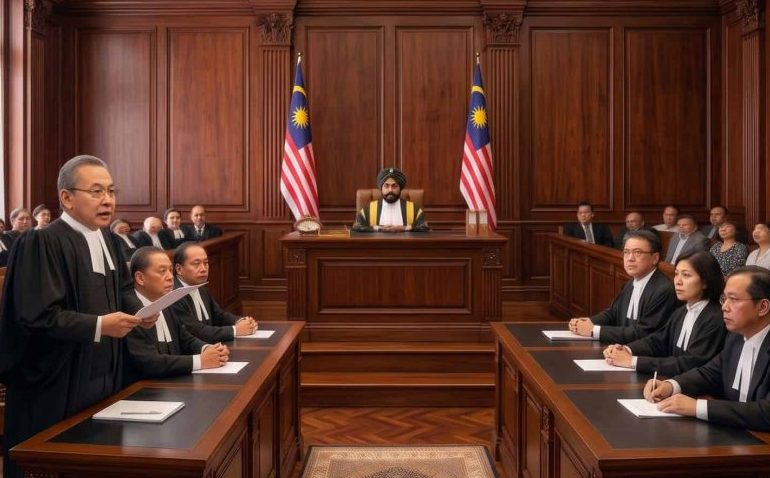
The special sitting began at 12.50 p.m.
Five judges sat. Tan Sri Wan Suleiman presided. With him were Tan Sri Mohamed Azmi, Tan Sri Eusoffe Abdoolcader, Tan Sri Wan Hamzah and Datuk George Seah.10PEP Report (n 1) paras 2.66 and 18.5.
The hearing took half an hour. The court rose briefly to consider. It came back and made its order. The five were unanimous.11PEP Report (n 1) para 2.66, citing para 5.13 of the report of the Second Tribunal.
Read what the order actually did. Almost every account of 1988 overstates it.
It did not stop the tribunal sitting. It did not stop it deliberating. It quashed nothing. It decided nothing about Tun Salleh’s case. It restrained one act only: sending the report to the King. And it did that only “until further order.”12PEP Report (n 1) para 2.68.
A pause, of unstated length, on one step.
That is the order for which five judges of the Supreme Court were suspended four days later.
The seal
Then came the part that nobody plans for.
An order of court is not finished when the judges say the words. It must be drawn up, signed and sealed. The seal is the court’s own mark. Without it the paper is not an order. It is a piece of paper.
The Chief Registrar came to Tan Sri Wan Suleiman with a message. The registry staff had been instructed by the acting Lord President not to be involved.13PEP Report (n 1) para 2.67.
So Wan Suleiman signed the order himself.
And the seal was affixed by a Senior Assistant Registrar named Soo Ai Lin.14ibid. The Report names her. A search of the published accounts of the crisis carried out on 8 August 2026 found no other source that does.
What followed, in nineteen days
On 5 July the acting Lord President had a consultation with the Prime Minister.15PEP Report (n 1) para 2.69, citing para 1.1 of the report of the Second Tribunal.
After it, he wrote to the King. The five judges who sat on Saturday were guilty of gross misbehaviour, he said. They should be removed. The charges were set out in an appendix. That same day the Prime Minister wrote to say he had no objection.16PEP Report (n 1) para 2.69, citing para 1.5 of the report of the Second Tribunal.
The King agreed the same day. A second tribunal would be set up. The five were suspended with effect from 6 July.17PEP Report (n 1) para 2.70.
Three days from the order to the suspension of every judge who made it.
On 7 July the first tribunal sent its report to the King.
The order of 2 July was still in force. It had not been set aside, discharged or varied. Suspending the judges who made it did not touch it. The 2008 Panel of Eminent Persons says so in two flat sentences, and leaves it there.18PEP Report (n 1) para 2.71.
The tribunal did the one thing a court had told it not to do.
On 14 July the Attorney General filed a motion to set the order aside. On 22 July a differently constituted bench of five judges set it aside.19PEP Report (n 1) para 2.72.
Look at who was available to sit.
Tan Sri Hashim Yeop Sani and Dato’ Harun Hashim were the only Supreme Court judges left who could. Six had been suspended. Two more were respondents in the proceedings. So the bench was made up with three High Court judges, sitting temporarily as Supreme Court judges. They were Dato’ Mohd Yusoff bin Mohamed, Dato’ Gunn Chit Tuan and Dato’ Annuar Zainal Abidin.20PEP Report (n 1) paras 2.73–2.74. The order of 22 July 1988 appears as Annexure 5 at page cxxix of the report of the Second Tribunal.
In seven weeks the highest court in Malaysia had been reduced to two usable judges.
One of the two was Harun Hashim. He had stayed in Kota Bharu. He now sat on the bench that undid the order made by the colleague who came back.
The month nobody explains
The first tribunal reported on 7 July. Tun Salleh was not removed until 8 August.21PEP Report (n 1) para 2.75.
A month is a long time here. The whole affair, from the letter of 26 March to the last day of the hearing, had taken ninety-six days.
The Panel calls the delay “uncharacteristic.” It offers a reason. The pause was likely caused by doubts arising from the failure to obey the court order of 2 July.22ibid.
If that is right, somebody in authority spent that month worrying about a piece of paper.
The paper had been signed by a judge because the registry had been told to stay out of it.
The seal on it had been pressed by a Senior Assistant Registrar who came in on a Saturday.
Next: Chapter 7 — Tribunal Two, and the charge sheet.
Further reading. The Report of the Panel of Eminent Persons to Review the 1988 Judicial Crisis in Malaysia (2008) is published in full, free, by the Malaysian Bar.
∞§∞
This article is written for a general readership and does not constitute technical or legal advice. Readers with legal questions are encouraged to seek independent legal advice.
The author thanks KN Geetha, TP Vaani, JN Lheela, and Lydia Jaynthi at GK Legal. Our gratitude to Gemini for the Ai generated image.
Claude, Anthropic’s AI, smoothed the drafting; Perplexity Pro checked the facts. The argument, the views, and the errors remain the author’s.
@Copyright reserved.
All content on this site, including but not limited to text, compilation, graphics, documents, and layouts, is the intellectual property of GK Ganesan Kasinathan and is protected by local and international copyright laws. Any use shall be invalid unless written permission is obtained by writing to gk@gkganesan.com.”