
Negeri Sembilan—the nine that became one [1/NS]
Negeri Sembilan is Malaysia’s only state that elects its ruler. Here is the six-century machine behind the throne.
The bottom line
Negeri Sembilan is the one Malaysian state that does not inherit its ruler. It elects him. Four territorial chiefs, the Undang, choose the Yang di-Pertuan Besar under a custom carried from Sumatra some six centuries ago. Before you can follow the quarrel now sitting in the courts, you have to meet the machine that makes the ruler — because almost every question in the dispute is really a question about that machine. This first essay builds it from the ground up, and takes no side in the present case.
How you choose a chief
Begin where the trouble begins: with the choosing of a man.
More than a hundred years ago a British officer named Andrew Caldecott set down, in patient detail, how the people of Jelebu pick a new Undang — their ruling chief.1 A. Caldecott, “Jelebu: Its History and Constitution”, in R.J. Wilkinson (ed.), Papers on Malay Subjects (1912), pp. 348–349. The same passage was relied on by Abdul Hamid Omar FJ in Dato Menteri Othman bin Baginda v Dato Ombi Syed Alwi bin Syed Idrus [1981] 1 MLJ 29. When an Undang dies, a chief minister of the luak — the district — becomes regent, and his word for the moment is law. Three clan headmen, the lembaga, then come to him and ask him to find a new chief. He passes the request down to another officer, who calls the eligible heirs and tells the family whose turn it is to put forward a candidate. The candidate is examined: is he of the right line, has the law of inheritance been kept? If he passes, he is sent up to be weighed against custom, and finally presented to a council of eight, “with whom rests his final acceptance or rejection.”2 Caldecott, “Jelebu”, in Wilkinson (ed.), Papers on Malay Subjects (1912), p. 349 (short extract).
Read that again, slowly, because everything else follows from it. A chief in Negeri Sembilan is not born to the office and is not simply appointed by a higher power. He is put forward, examined, and accepted — by a chain of people, each with a defined role, working through a settled procedure. The office runs through the family by descent, but a particular man only gets it by passing through the procedure. That is the single most important idea in this entire series. Hold on to it.
Why a state would choose its own king
The other Malay states do it differently. There a sultan dies and, broadly, his heir succeeds; the throne descends like a house, from one holder to the next. Negeri Sembilan does not work that way, and the reason is buried in its history.
The settlers who shaped the state came from the Minangkabau highlands of West Sumatra, beginning around the fifteenth century, moving first under Malacca and later under Johor.3 P.E. de Josselin de Jong, Minangkabau and Negri Sembilan: Socio-Political Structure in Indonesia (Leiden thesis; The Hague, 1951); M.B. Hooker, Adat Laws in Modern Malaya (Oxford University Press, 1972). They brought with them a body of custom — adat — and in particular the strand known as Adat Perpatih. It is worth pausing on the word, because foreign readers, and a surprising number of lawyers, get it wrong.
Adat Perpatih is matrilineal. Land, the family house, and the clan name pass from mother to daughter, not from father to son.4 Hooker, Adat Laws in Modern Malaya (1972); E.N. Taylor, “The Customary Law of Rembau”, Journal of the Malayan Branch of the Royal Asiatic Society VII (1929). The matrilineal property and the elective office are two different things: property descends through women; the chiefly office is filled by election within an eligible male line. Decisions are reached by mufakat — consensus, talked out among the people whose business it is. It is the opposite of rule by a single commanding voice. (Its cousin, Adat Temenggung, found in the other states, is patrilineal and far more comfortable with a single ruler at the top.) A society organised around consensus and the maternal line does not naturally produce a hereditary king. It produces electors. And so, when Negeri Sembilan finally needed a head, it elected one.
The moment is dated. By 1773 Johor had weakened and raiders pressed the small Minangkabau settlements, and so the chiefs sent envoys back across the water to the ancestral court of Pagaruyung in Sumatra, asking for a prince to rule over them. The prince who came, Raja Melewar, became the first Yang di-Pertuan Besar.5 de Josselin de Jong, Minangkabau and Negri Sembilan (1951); the elective character of the office is set out in Dato Menteri Othman bin Baginda v Dato Ombi Syed Alwi bin Syed Idrus [1981] 1 MLJ 29 (Salleh Abas FJ). Note the shape of the thing. The chiefs did not crown one of their own. They sent for a ruler — and they kept the sending in their own hands. The ruler came from outside; the power to choose him stayed inside. It has stayed inside ever since.
Nine, more or less
The name itself is an honest little puzzle. Negeri Sembilan means “Nine States”. Which nine?
The answer, in the way of these things, turns out to be flexible. The original confederacy gathered together a shifting set of small territories — among them Sungai Ujong, Jelebu, Johol, Rembau, and others such as Naning, Segamat, Klang, Jelai and Pasir Besar.6 Boundaries and membership shifted across the eighteenth and nineteenth centuries: Naning was absorbed into Malacca after the Naning War (1832), Segamat passed to Johor, Klang to Selangor. See de Josselin de Jong, Minangkabau and Negri Sembilan (1951). Over the following century the membership moved about: Naning was swallowed into Malacca after a small war, Segamat drifted to Johor, Klang to Selangor. The “nine” was less a fixed list than a remembered idea. What endured was not the exact count but the federal instinct — the habit of separate territories agreeing to act, on the great questions, together.
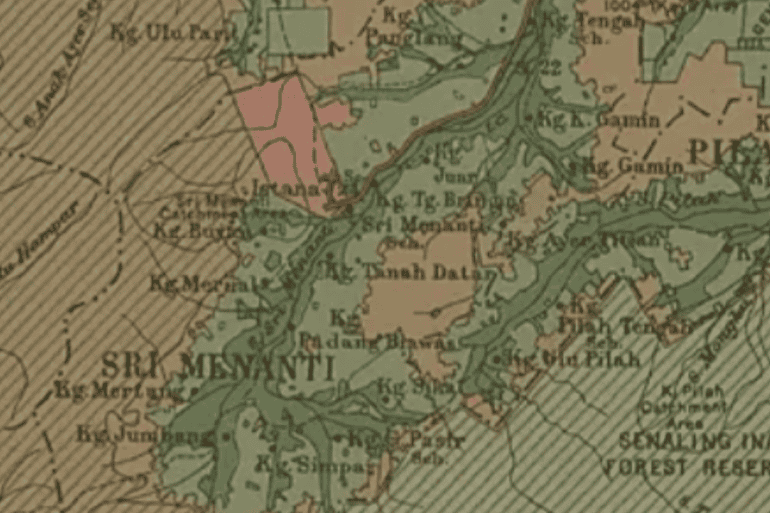
Four of those territories settled into the role that matters for the present crisis. They are the Undang Yang Empat — the Four Undang — of Sungai Ujong, Jelebu, Johol and Rembau.7 The four ruling-chief territories are confirmed in the Laws of the Constitution of Negeri Sembilan 1959 (2008 Reprint, incorporating amendments to 1 January 2008), Article XIV(1). Each Undang is the elected head of his luak, chosen by his own clan headmen in his own way, by the kind of procedure Caldecott described. And it is these four, acting together, who elect — and in defined circumstances may move against — the ruler of the whole.
The British did not abolish it; they wrote it down
The British arrived, as the British did, and the natural expectation would be that an elaborate native constitution would be swept aside for something tidier. That is not quite what happened.
In 1889 the territories were knit into “a Confederation of States to be known as the Negeri Sembilan” — the language a Federal judge would later quote — and in 1895 the state entered the Federated Malay States.8 The 1889 confederation and the elective system are described by Salleh Abas FJ in Dato Menteri Othman [1981] 1 MLJ 29. The first British Resident of Negeri Sembilan was Martin Lister (Resident 1889–1891 and 1895–1897). The first British Resident, Martin Lister — son of an English baron, and destined to die young aboard a steamer at Suez — found himself administering a system far older and stranger than anything in the colonial handbook.9 Martin Lister (1857–1897) died at Suez aboard the SS Sydney, aged about forty. Biographical detail is incidental to the constitutional point and is included for context only. The colonial answer, in the end, was the prudent one: do not fight the custom you cannot understand. Work with it. Keep its machinery and bolt your own administration onto the side.
So the old order was not erased. It was carried forward — and eventually carried into a written document, the Laws of the Constitution of Negeri Sembilan, in 1959. That is the genuinely interesting thing about this state, and the source of every difficulty to come. In most places, “the constitution” is a modern paper that replaces the old ways. In Negeri Sembilan, the modern paper absorbed the old ways. Ancient custom did not retire when the written constitution arrived. It moved in.
What this sets up
Three threads run out of this history and into the essays that follow, and it is worth naming them now.
First, the ruler is elected, not inherited — which means the identity and the number of the electors is never a side issue. If four chiefs choose the ruler, then who counts as a chief, and how many of them must agree, becomes the whole ball game. We will meet that arithmetic again.
Second, custom and written law now live in one house. A constitution that has taken custom inside itself must, sooner or later, decide what happens when the two disagree. That is not an abstract worry; it is the engine of the current dispute.
Third — and this is the one to sit with — a system built on consensus has no comfortable way to handle a deadlock. Mufakat assumes that reasonable people, talking long enough, will agree. The machinery is magnificent when everyone is talking. The question nobody designed for is the one now being asked: what happens when they stop?
That question is not for this essay. The next one opens the machine and shows you the levers — so that, when a lever is pulled in anger, you can see exactly which one.
This is essay 1 of six in a linked series on the 2026 Negeri Sembilan constitutional dispute. The series explains the law and the history; it does not take a position on the matters now before the courts.10 On the discipline of commenting carefully while litigation is pending, see GK Ganesan, “Is the sub-judice rule dead?”, https://www.gkg.legal/is-the-sub-judice-rule-dead/ . On the writing register used in the historical passages of this series, see “The Peter Mooney I knew”, https://www.gkg.legal/the-peter-mooney-i-knew/ .
∞§∞
This article is written for a general readership and does not constitute technical or legal advice. Readers with legal questions are encouraged to seek independent legal advice.
The author thanks KN Geetha, TP Vaani, JN Lheela, and Lydia Jaynthi at GK Legal.
Claude, Anthropic’s AI, smoothed the drafting; Perplexity Pro checked the facts. Advocate, editor and sceptic together made one essay better than any could alone. The argument, the views, and the errors remain the author’s.
@Copyright reserved.
All content on this site, including but not limited to text, compilation, graphics, documents, and layouts, is the intellectual property of GK Ganesan Kasinathan and is protected by local and international copyright laws. Any use shall be invalid unless written permission is obtained by writing to gk@gkganesan.com.