The Party Splits [Part 2/11-The Malaysian Judiciary Then and Now]
Thirty branches. Nobody had registered them. That was enough to kill the party that had governed Malaysia since independence. Not a coup. Not a scandal. Thirty forms nobody had filed.
Chapter 2 of What the Judiciary Was and What It Has Become
[A record of the Malaysian Judiciary, before 1988 to now]
Thirty branches. Nobody had registered them.
That was enough to kill the party that had governed Malaysia since independence.
Not a coup. Not a scandal. Thirty forms nobody had filed.
Forty-three votes
Chapter 1 closed on a party election the Prime Minister very nearly lost. This is that election.
A word first about the party. UMNO — the United Malays National Organisation — was founded in 1946. It was the largest party in the governing coalition. Whoever led UMNO led the country. So a fight for the party presidency was a fight for the office of Prime Minister, held indoors, among members.
The fight came on 24 April 1987, at the party’s general assembly.1Mohd Noor bin Othman & Anor v Mohd Yusof Jaafar & Ors [1988] 2 MLJ 129 (HC), summary of facts.
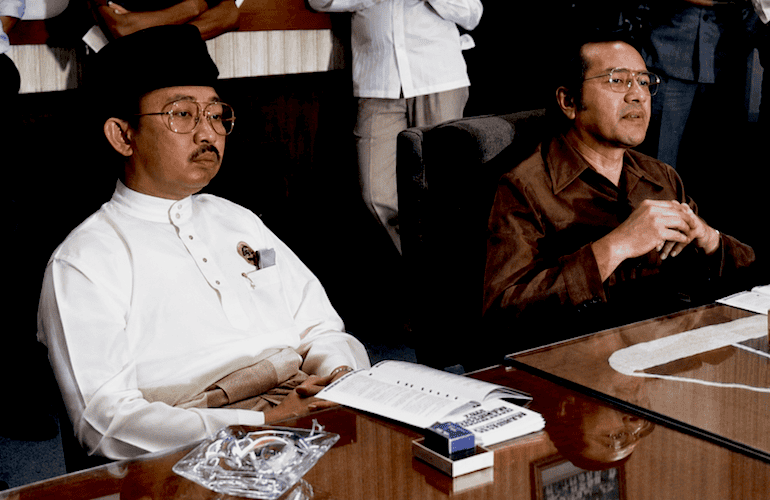
Dr Mahathir Mohamad defended the presidency. Tengku Razaleigh Hamzah challenged him. The newspapers called the two camps Team A and Team B, and the names stuck.
Dr Mahathir won. The count was 761 votes to 718.2Panel of Eminent Persons, Report of the Panel of Eminent Persons to Review the 1988 Judicial Crisis in Malaysia (Malaysian Bar Council, International Bar Association, LAWASIA and Transparency International–Malaysia, 26 July 2008) (‘PEP Report’) para 2.8.
A margin of forty-three.
Move twenty-two votes and the country has a different Prime Minister. Team B did not accept the result. In June 1987 twelve of its members went to the High Court.3PEP Report (n 2) para 2.8; Mohd Noor (n 1), recording twelve plaintiffs. Popular accounts call them the “UMNO 11”, one plaintiff having withdrawn before judgment. The law report records twelve.
They asked for one thing. Declare the election void. Hold it again.
An unlawful society
Their argument was small and technical. It was also, as it turned out, fatal.
A political party in Malaysia is a society. It must be registered under the Societies Act 1966. So must every one of its branches. UMNO had roughly eight thousand branches.
Thirty of them had never been approved by the Registrar of Societies. This was not in dispute. Both sides agreed it.4Mohd Noor (n 1), summary: “It was not disputed that there were 30 unapproved branches (unapproved by the Registrar of Societies) in four divisions.”
Those thirty branches had held meetings. They had elected delegates. Those delegates went up to the divisions. From the divisions they went to the general assembly. There they voted.
Team B said the election was tainted. They wanted a fresh one.
The judge gave them something else entirely.
Harun Hashim J read two sections of the Act together. Section 12(3) says a branch set up without approval is an unlawful society. Section 41(c) says so again, in different words.
An unlawful society is not merely a society in trouble. It is a body the law refuses to recognise at all. It cannot own property. It cannot sue. Belonging to it is an offence.
And the judge held that the poison ran upwards. If the branch was unlawful, so was the parent.
“From the moment the first unapproved branch was established, not only the unapproved branch so established was an unlawful society but also UMNO itself.”5Mohd Noor (n 1), holding (1).
He said it, by all accounts, with no pleasure: “Very sadly, I have to make a finding in law that, at the material time, UMNO was an unlawful society.”6Quoted in Harun M Hashim Law Centre, International Islamic University Malaysia, ‘Tan Sri Dato’ Harun Mahmud Hashim’ https://lawcentre.iium.edu.my/harunmhashim.html accessed 8 August 2026. The remark does not appear in the law report and is taken from a secondary source.
The date was 4 February 1988.7PEP Report (n 2) para 2.21.
A victory that helped nobody
Team B had won an argument and lost everything.
The elections were a nullity, the judge held — every one of them, at every level. But the plaintiffs were members of an unlawful society. The law would not hand them a remedy built on something the law called unlawful. Their claim was dismissed.8Mohd Noor (n 1), holdings (3) and (4).
So the party the plaintiffs wanted to correct no longer existed to be corrected.
Consider where that left the country. The Prime Minister still commanded a majority in Parliament, so he remained Prime Minister. He simply had no party.
That was arranged within a fortnight. A new party was registered, called UMNO Baru — New UMNO. Its leadership was drawn from Team A. Team B was not invited.9The exact registration date is variously reported as 13, 16 and 25 February 1988. This series has not been able to settle it against a primary record and does not assert one. What is agreed on every account is that it happened within about three weeks of the judgment.
Team B applied to register a party of their own. The Registrar refused them. They tried the name UMNO Malaysia. Then UMNO 46. Both were turned away.
Eventually they were allowed Semangat 46 — the Spirit of ’46, after the year the original party was born. It was registered on 3 June 1989, sixteen months after the judgment.10The formation and registration of Semangat 46 are drawn from standard secondary accounts; the Registrar of Societies’ own file has not been inspected for this series.
One faction lost a party election by forty-three votes. It went to court. It came out with no party at all, and waited more than a year for permission to build another.
The appeal that was never heard by nine
Team B appealed. The notice went in on 19 February 1988.11PEP Report (n 2) para 2.21.
Everything now turned on that appeal. If the Supreme Court reversed Harun Hashim J, the old UMNO came back to life. Its 1987 election would stand void. The Prime Minister would face again the contest he had almost lost.
On 23 May 1988 the Lord President, Tun Salleh Abas, fixed the appeal for 13 June. He directed that nine judges should sit.12PEP Report (n 2) para 2.32.
No Supreme Court appeal in Malaysia had ever been heard by more than five.
The reason for nine was not mysterious. There were ten Supreme Court judges. One of them was Harun Hashim, who had tried the case below and could not sit on his own decision. Nine meant every judge who was free to sit would sit.
Nobody could then say the bench had been picked. The 2008 Panel that reviewed all this called it “the most appropriate direction that could have been given.”13PEP Report (n 2) para 2.33.
Two days later the Prime Minister wrote to the King about the Lord President. On 26 May Tun Salleh was suspended.14PEP Report (n 2) paras 2.34–2.35.
On 27 May the acting Lord President, Tan Sri Abdul Hamid Omar, cancelled the nine-judge bench and vacated the hearing date.15PEP Report (n 2) para 2.37.
Four days from the direction to its cancellation. Chapters 4 to 7 are about what happened in between.
Five judges, on the ninth of August
The appeal was finally decided on 9 August 1988.
Tun Salleh Abas had been removed from office the day before.16PEP Report (n 2) para 2.75; Office of the Chief Registrar of the Federal Court of Malaysia, ‘Former Chief Justice’ https://www.kehakiman.gov.my/en/about-us/court/federal-court/former-chief-justice accessed 8 August 2026, giving his term as ending 8 August 1988.
The bench was five, not nine. It is worth reading the names slowly.17Mohd Noor bin Othman & Ors v Haji Mohamed Ismail bin Haji Ibrahim & Ors [1988] 3 MLJ 82 (SC) (‘Mohd Noor (SC)’). Coram: Abdul Hamid Ag LP, Lee Hun Hoe CJ (Borneo), Hashim Yeop A Sani SCJ, Mohamed Yusoff and Gunn Chit Tuan JJ; judgment 9 August 1988. Coram and date verified on Lexis Advance, 8 August 2026.
Tan Sri Abdul Hamid Omar sat as acting Lord President. He was the judge who had cancelled the nine. He had chaired the tribunal that recommended Tun Salleh’s removal. Three months later the office was his.
Tan Sri Lee Hun Hoe, Chief Justice (Borneo), had sat on that same tribunal.
Tan Sri Hashim Yeop A Sani was appointed three days later to chair a second tribunal, to try five of his own colleagues.18PEP Report (n 2) paras 2.76–2.79; appointment dated 12 August 1988.
The remaining two, Mohamed Yusoff and Gunn Chit Tuan, were High Court judges sitting up.
The appeal was dismissed.
And then the Court did one thing more. Harun Hashim J had added a line in his written grounds: the office-bearers elected back in 1984 continued to be UMNO’s lawful office-bearers. It was the single finding that gave Team B any foothold at all in the old party.
On a cross-appeal, the Supreme Court set that line aside as wrong in law.19Mohd Noor (SC) (n 17), holdings (2) and (4).
Everything Harun Hashim J had decided against the challengers was upheld. The one thing he had decided that might have helped them was removed.
A small correction
It is often written that seventy-four branches were unregistered. Both courts recorded thirty, in four divisions, and neither side disputed the figure.20Mohd Noor (n 1); Mohd Noor (SC) (n 17). The figure of seventy-four appears in, among others, the Grokipedia entry on the 1988 crisis, accessed 8 August 2026.
Thirty is the number. It is small enough to be worth keeping accurate.
A party of forty-two years, dissolved by a filing failure in thirty branches out of eight thousand.
A Prime Minister who kept his office by losing his party, and got a new one inside a month.
And a bench of nine, ordered so that nobody could complain about the bench, which never sat.
Next: Chapter 3 — A judiciary that talks back.
Further reading. The Report of the Panel of Eminent Persons to Review the 1988 Judicial Crisis in Malaysia (2008) is published in full, free, by the Malaysian Bar.
∞§∞
This article is written for a general readership and does not constitute technical or legal advice. Readers with legal questions are encouraged to seek independent legal advice.
The author thanks KN Geetha, TP Vaani, JN Lheela, and Lydia Jaynthi at GK Legal. Our gratitude to Free Malaysia Today for the image.
Claude, Anthropic’s AI, smoothed the drafting; Perplexity Pro checked the facts. The argument, the views, and the errors remain the author’s.
@Copyright reserved.
All content on this site, including but not limited to text, compilation, graphics, documents, and layouts, is the intellectual property of GK Ganesan Kasinathan and is protected by local and international copyright laws. Any use shall be invalid unless written permission is obtained by writing to gk@gkganesan.com.”