Does our rubbish have a religion?
Two friends bin a beer and a coffee together. So why must Selangor’s rubbish now declare its faith?
We should make gentle inquiry into the theology of the wheelie-bin.
To quote Mariam Mokhtar: Two friends sit in a shopping mall. One drinks a coffee.1 To borrow Mariam Mokhtar’s example on https://youtu.be/SyVpfGwJaak?si=fCBFy31uYqnMGwQ9in . The other drinks a beer. They finish. They stand. They drop both cups into the same bin.
No one stops them. No one inspects the cups. No one asks the bin its faith.
That is how public waste works. It always has. Rubbish is anonymous. It is mixed, compressed, and carted away in bulk. Once a thing enters the bin, its history is gone. Nobody can say who used it, or what it once held, or whether it was pious.
And yet, in Selangor, we have lately been asked to try.
A SHORT WALK THROUGH THE RUBBISH THEOLOGY DEPARTMENT
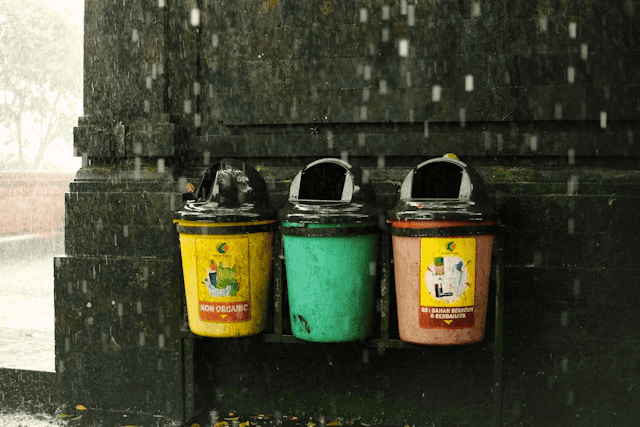
The story is now on the public record. Planning guidelines tied to malls and hypermarkets spoke of separating waste by category: halal organic, non-halal organic, and the rest. When people objected, officials explained that the rule was old — from around 2010 — and applied mainly to the large collection areas behind the shops, not to every bin in the food court.2‘COMMENT | Can trash be halal?’ Malaysiakini (Kuala Lumpur, 21 June 2026) https://www.malaysiakini.com/columns/777863 accessed 2 July 2026.
That clarification raised more questions than it settled.
If the rule is fifteen years old, why are we only hearing of it now? Why did it surface, blinking, into daylight only after a fuss? It has the same quiet quality as an earlier planning matter concerning non-Muslim places of worship — kept low, noticed late.
The state councillor for local government offered the detail that undid the whole edifice. He confirmed that the waste is combined before incineration. All of it. Together.3Statement of the Selangor executive councillor for local government and tourism, reported in Malaysiakini and related coverage, June 2026, confirming that segregated waste is ultimately disposed of together prior to incineration.
Pause on that. The bins are separated. The lorry combines them. The furnace burns them as one. Somewhere between the bin and the flame, the theology evaporates.
Peter Mooney would have set down his pipe at this point. He would have said, very softly, “Ah. Here comes nonsense.”
WHAT THE LAW ACTUALLY PROTECTS
Let us be fair to the Constitution, which is often quoted and seldom read.
Article 3 declares the religion of the Federation, and provides that other religions may be practised in peace and harmony.4Federal Constitution of Malaysia, art 3. Article 11 gives every person the right to profess and practise his religion.5Federal Constitution, art 11. Article 4 makes the Constitution supreme, and any inconsistent law void to the extent of the inconsistency.6Federal Constitution, art 4(1).
Notice the word the Constitution uses. Person. Not banana peel. Not chicken bone. Not last night’s takeaway box.
Rights belong to people. People believe, doubt, choose, and answer for their choices. A person may eat this and refuse that, and carry the consequences in his own conscience. Rubbish does none of this. Rubbish does not choose. Rubbish merely happens. It is the silent residue of a choice already made and already past.
To give rubbish a religion is to promote it. It rises from evidence to participant. The half-eaten burger in the bin is not a citizen of any faith. It is the forensic remains of someone’s lunch. It has no mind, no conscience, and no soul. It has only a smell.
THE FAITH’S OWN SCHOLARS ARE UNIMPRESSED
Here is the part the bin-sorters seem to have missed. The religious law they invoke does not ask for any of this.
Classical jurisprudence has thought about impurity with great care. It has a settled doctrine, najasah, on what is impure and how it is cleansed.7On the classical law of ritual impurity (najasah) and its removal, see IslamQA, ‘Impurity (Najasah): its types and how to purify things’ (31 August 2024) https://islamqa.info/en/answers/510163 accessed 2 July 2026. And it has a second doctrine, more elegant still, called istihalah — purification by transformation.8On istihalah (purification by transformation of substance), see Fazeli Behsoodi, ‘Lesson 12: Purifying Things (Muṭahhirāt): Things That Purify an Impure Object’ (31 January 2024) https://fazelibehsoodi.com/en/ accessed 2 July 2026.
The idea is simple and rather beautiful. When a substance changes its nature, its impurity falls away. Wine that turns to vinegar is pure, and so is its jar. Filth that is burned becomes ash. Sewage that is treated becomes water. Waste that rots becomes soil.
The doctrine is not a modern invention. In 1978, a senior Saudi council ruled that treated wastewater, once purified, could be used again — the ancient principle applied to a modern treatment plant.9Council of Senior Scholars (Saudi Arabia), fatwa on the purification and reuse of treated wastewater (1398 AH/1978), widely cited in Islamic environmental and water-management literature.
Do you see the joke writing itself? The jurists already agree with the waste engineers. Both say the same thing in different tongues. The engineer says rubbish loses its identity in the system. The jurist says impurity loses its identity through transformation. Two doors. One room.
Nowhere — nowhere — do the classical texts demand a bin marked “for the unclean.” There is no fatwa requiring a rubbish lorry with a halal compartment in front and a non-halal compartment behind, the driver switching his intention at every stop. The law of impurity is practical and merciful. It was never meant to become a municipal theology of the wheelie-bin.
THE WASTE THAT TRULY NEEDS SORTING
The strange thing is that we already know how to separate rubbish sensibly. We do it every day, and no scripture is required.
We separate medical waste, because it carries infection. We separate radioactive waste, because it damages the unborn and invites cancer. We separate chemical waste, because it poisons water. We separate electronic waste, because it leaks toxic metals into the soil.10On the risk-based classification of hazardous waste streams generally, see the Environmental Quality Act 1974 (Act 127) and subsidiary regulations; and the Solid Waste and Public Cleansing Management Act 2007 (Act 672).
These categories share one honest feature. They remain dangerous after disposal. The danger is real, measurable, and indifferent to belief. Plutonium does not care what you pray. A hepatitis needle infects the devout and the doubtful alike.
That is risk-based governance. It sorts by hazard, not by identity.
Now hold a coffee cup against that standard. What measurable danger does it carry once discarded? None. What does its “religious status” threaten in the landfill? Nothing. And how, once it is crushed among ten thousand others, would anyone even trace it? They could not.
Meanwhile, the real hazards wait for attention. Rivers are polluted. Landfills strain. Recycling limps. In places up north, electronic waste has been dumped and burned, and residents have breathed the fumes for years.11On illegal e-waste dumping and processing in Malaysia and related enforcement actions, see reporting on seizures and operations in Perak and Kedah, and the framework under the Environmental Quality Act 1974 (Act 127). There is the rubbish that deserves our anxiety. It is dangerous whatever its faith.
A VERY HUMAN FOLLY
Before we imagine this is one nation’s peculiarity, or one faith’s, let us be honest. The urge to make refuse sacred is old, and it is everywhere.
Jewish law will not throw away a worn text that bears the name of God; it is buried with dignity in a genizah.12On the practice of genizah (the reverent storage and burial of sacred texts bearing the divine name), see standard reference works on Jewish law and custom. Hindu tradition draws deep lines around purity and pollution, lines that fell most cruelly on the very people made to handle waste.13On ritual purity and pollution in Hindu tradition and its historical social consequences, see general scholarship on caste and the treatment of sanitation labour in India. Zoroastrians guard the purity of fire, earth, and water so strictly that even the dead may not defile them. The old Shinto sense of kegare — defilement — treats impurity as something to be swept clean by ritual.
The impulse is human, not sectarian. We meet a mess, and we reach for meaning. We would rather bless a bin than empty it.
And here the gentlest irony of all. The same faith now invoked for halal bins teaches, plainly, against waste itself. Its scholars have written, with visible embarrassment, of the irony that the devout who fuss over what is halal to eat will then throw away mountains of food each festive season — in flat defiance of the command against extravagance.14Institut Kefahaman Islam Malaysia (IKIM), ‘The Irony of Food Waste Amongst Muslims’ (3 June 2019) https://www.ikim.gov.my/the-irony-of-food-waste-amongst-muslims/ accessed 2 July 2026; and see Qur’an 7:31 (‘…eat and drink, but be not extravagant…’).
There is the sermon the rubbish actually preaches. Not which bin, but why so much.
WHAT THE BIN IS REALLY TELLING US
So we have invented, it seems, “Rubbish Piety” — a great labour of sorting — while quietly failing at “Rubbish Reduction,” which every faith and every environmental law commends.15On Islamic environmental ethics and waste reduction, see ‘Islamic Ethics of Waste Management towards Sustainable Environmental Health’ (International Medical Journal Malaysia, 2022); and IKIM (n above).
Should a policy of this kind ever be tested in court, it would face a simple question. Article 4 requires a rational connection between a rule and its lawful aim.16Federal Constitution, art 4(1); and on the requirement of rationality in administrative and constitutional review generally. “Public health” is the aim usually pleaded. But health officers do not ask for halal bins. They ask for sealed bins, prompt collection, and proper landfills. None of that improves if one bin wears a label and the other does not. And a rule that in practice falls hardest on non-Muslim restaurants, or on the shop that sells a beer, begins to look less like sanitation and more like something else, entering by the service corridor.17Human Rights Commission of Malaysia (SUHAKAM), ‘Freedom of Religion’ (SUHAKAM, 12 January 2022) https://suhakam.org.my/portfolio/freedom-of-religion/ accessed 2 July 2026.
Constitutional law, at bottom, is about taking people seriously. Their beliefs. Their dignity. Their freedom. When a rule starts to take the rubbish more seriously than the people — assigning a creed to the leftovers while burdening the living — it has wandered off the path.
The absurdity is not in the faith. The faith has a mature and merciful law of purity, and a firm command against waste. The absurdity is in the official who found theology in a compost heap.
So: does our rubbish have a religion?
No. It has only the tendencies we give it. To pile up when we are wasteful. To pollute when we are careless. And, now and then, to become a minor celebrity when we grow too clever by half.
The Constitution speaks of every person. The scripture speaks against extravagance. Neither says a word for the banana peel.
They were both, all along, speaking about us.
∞§∞
This article is written for a general readership and does not constitute technical or legal advice. Readers with legal questions are encouraged to seek independent legal advice.
The author thanks KN Geetha, TP Vaani, JN Lheela, and Lydia Jaynthi at GK Legal. Our gratitude to Aditya Nara of Unsplash for the image.
Claude, Anthropic’s AI, smoothed the drafting; Perplexity Pro checked the facts. The argument, the views, and the errors remain the author’s.
@Copyright reserved.
All content on this site, including but not limited to text, compilation, graphics, documents, and layouts, is the intellectual property of GK Ganesan Kasinathan and is protected by local and international copyright laws. Any use shall be invalid unless written permission is obtained by writing to gk@gkganesan.com.