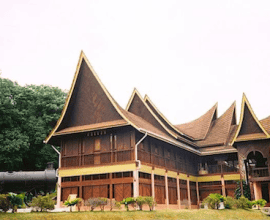

The Best Statute Nobody Uses [Part 4/5]
Thirty ringgit turns five mortal trustees into a body corporate that never dies — and escapes the Companies Act entirely.
The last essay left A’s temple in an uncomfortable place. Its land sits on the title in the names of five men. The trust is invisible. The men are mortal. And if the committee ever needs a court’s help, it may have to ask the Attorney General for permission first.
The answer has been in the statute book since 1952, and in my experience most committees have never heard of it.
What it does
The Trustees (Incorporation) Act 1952 allows the trustees of a body established for a religious, educational, literary, scientific, social or charitable purpose to apply to the Minister for a certificate. If he considers incorporation expedient, he grants one.1Trustees (Incorporation) Act 1952 (Act 258), s 2.
At that moment the trustees stop being five men who happen to hold land together.2The usual limit of four trustees does not apply to property vested in trustees for charitable, religious or public purposes: Trustee Act 1949 (Act 208), s 39(2). They become a body corporate — with its own name, its own seal, its own right to sue and be sued in that name, and, the crucial words, perpetual succession.
It never dies.
And here is the elegant part. The certificate itself vests in the new body corporate all the property, movable and immovable, held by anybody in trust for the institution.3Trustees (Incorporation) Act 1952, s 3. No transfer needs to be drawn. No consideration passes. The property moves because the certificate says so.
The Act then looks forward as well as back. Once the trustees are incorporated, every gift or disposition of land made in favour of the body — or of its trustees, or simply for its purposes — takes effect as though it had been made to the corporation.4Trustees (Incorporation) Act 1952, s 11. A will drawn in 1990 in favour of “the trustees of the temple” does not fail because those trustees are dead.
What it fixes
The mortal trustee. This is the big one, and it is solved completely. There is no longer any land standing in a private person’s name. When a trustee dies, nothing happens to the title. No estate, no executor, no grant of probate, no bewildered family looking at an asset in the inventory. The corporation held the land the day before he died, and holds it the day after.
The invisible trust. Not solved, exactly, but transformed. The register still records no trust — that remains the design of the land system. But the proprietor is no longer Mr Tan and four others. It is a named institution, incorporated by a certificate of the Minister, and the certificate is a public document recording the purposes. A searcher sees a body, not a man. And no one in the corporation is in a position to suggest, thirty years on, that the land was really his all along.
The evidence problem. The certificate is registered with the Minister, who keeps a record of all applications and documents and supplies copies.5Trustees (Incorporation) Act 1952, s 8. Your proof of title no longer depends on a deed in a cupboard.
The application costs thirty ringgit in stamp duty. So does the certificate.6Trustees (Incorporation) Act 1952, s 10.
What it does not fix
Now the honest half, because this Act is oversold by people who have not read all of it.
The Attorney General is still at the door. Section 9 of the Act says that the conditions and directions in the certificate bind the trustees as trusts, and are enforceable by the Attorney General or other interested persons under section 9 of the Government Proceedings Act 1956 — the very provision described in the last essay.7Trustees (Incorporation) Act 1952, s 9, which makes the conditions “enforceable by the Attorney General or other persons interested under section 9 of the Government Proceedings Act 1956”; Government Proceedings Act 1956 (Act 359), s 9. Incorporation does not sidestep the requirement of his written consent. It expressly imports it.
The Minister still controls how much land you may hold. When granting the certificate he may impose conditions — and the Act specifically mentions, among them, the qualifications and number of trustees, the mode of appointing new ones, the custody of the seal, the amount of the land which the trustees may hold, and the purposes for which that land may be applied.8Trustees (Incorporation) Act 1952, s 2.
So there is still a ministerial gate. It has simply moved. Under the Companies Act the gate stands in front of every acquisition, forever. Under this Act it stands once, at the entrance, and what you negotiate in the certificate is what you live with. That is a real improvement. It is not freedom.
Incorporation is discretionary. The Minister grants a certificate if he considers it expedient, having regard to the extent, nature and objects of the body. There is no entitlement.
And it can be taken away. The Minister may revoke a certificate on several grounds — incorporation obtained by fraud or misrepresentation, the body pursuing objects other than those it was established for, wilful contravention of the Act, and, in terms every religious body should read carefully, where the body is likely to be used for a purpose prejudicial to or incompatible with the security of Malaysia, or with public order or morality.9Trustees (Incorporation) Act 1952, s 17.
There are duties. The trustees must keep full and true accounts of all money received and paid, and prepare annual accounts of income, balances, payments, and sums owing, by 30 June each year or such other date as the Minister appoints.10Trustees (Incorporation) Act 1952, s 15. Bodies that have never filed anything should not assume nobody is counting. Since 2025 there is more: the Trustee (Amendment) Act 2025 inserts a new Part IVA requiring trustees of express trusts governed by Malaysian law to keep records and to hold a register of beneficial ownership.11Trustee (Amendment) Act 2025, Part IVA; and see the Trustee (Register of Beneficial Ownership) Regulations 2025 and the Trustee (Exemption) Order 2025.
Why it escapes the Companies Act entirely
Return to where this series began.
Section 45(4) of the Companies Act 2016 forbids a company limited by guarantee to hold land without the Minister’s licence.12Companies Act 2016 (Act 777), s 45(4).
A body incorporated under the 1952 Act is not a company limited by guarantee. It is not a company at all. It is not registered under the Companies Act, has no members in the corporate sense, no share capital, no directors, and no constitution filed with the Registrar of Companies.
The prohibition does not reach it. Not by argument, not by exception, not by any clever construction. It simply has nothing to say to a creature of a different statute.
There is a piece of history behind that which is worth knowing. Our 1952 Act descends from an English statute of 1872 — the Charitable Trustees Incorporation Act — which allowed the trustees of a charity to be incorporated by certificate in almost the same terms we use today. And the English Act said so in the plainest words: trustees might be incorporated notwithstanding the statutes of mortmain.13Charitable Trustees Incorporation Act 1872 (35 & 36 Vict c 24), s 1. Those words were repealed by the Charities Act 1960, Seventh Schedule, Part II — unnecessary by then, mortmain itself having gone.
The restriction and the escape from it were drafted as a pair. England repealed the escape clause in 1960 because it had abolished the thing the clause guarded against. We kept the guard and the thing both, and largely forgot which was which.
This is the cleanest answer in the series. The trust in the second essay works, and works well, and for many bodies it is the right answer. But it leaves land in private names, and it leaves a congregation depending on paperwork surviving forty years of committee changes. Incorporation under the 1952 Act removes both risks in a single document.
What to do this month
If your institution holds land through individual trustees, three steps.
Find the trust deed. Check it is stamped. If it is not, have it stamped now, with whatever penalty applies. An unstamped instrument is not merely inadmissible; it may not be acted upon or registered by a public officer either.14Stamp Act 1949 (Act 378), s 52(1).
Search the title and see whose names are actually on it. In my experience this produces surprises more often than not.
And take advice on incorporating the trustees. It is a short application, the duty is thirty ringgit, and it converts a fragile arrangement resting on five heartbeats into an institution that outlives everybody.
The question left over
So there is a way through. Two, in fact.
But notice what we have been doing for four essays. We have been finding routes around a prohibition, rather than asking whether the prohibition should be there at all.
Why may a religious body not simply own its own land?
That is the last essay.
You can view Part 1, Part 2, Part 3, and Part 5 here.
∞§∞
This article is written for a general readership and does not constitute technical or legal advice. Readers with legal questions are encouraged to seek independent legal advice.
The author thanks KN Geetha, TP Vaani, JN Lheela, and Lydia Jaynthi at GK Legal. Our gratitude to Worshae of Unsplash for the image.
Claude, Anthropic’s AI, smoothed the drafting; Perplexity Pro checked the facts. The argument, the views, and the errors remain the author’s.
@Copyright reserved.
All content on this site, including but not limited to text, compilation, graphics, documents, and layouts, is the intellectual property of GK Ganesan Kasinathan and is protected by local and international copyright laws. Any use shall be invalid unless written permission is obtained by writing to gk@gkganesan.com.