
The Constitutional Amendment [Part 8/11-The Malaysian Judiciary Then and Now]
Fourteen words went out. Three went in. What the courts had held by right, they now held by permission. Parliament gives. Parliament may take away.
…
The heading is still there. Underneath it, there is none.
Chapter 8 of What the Judiciary Was and What It Has Become
[A record of the Malaysian Judiciary, before 1988 to now]
On Friday, 10 June 1988, a short Act came into force.
The next morning the Prime Minister sent the King six names. That was the tribunal which removed Tun Salleh Abas. Chapter 5 began there.
One day lies between the two events. Almost nobody notices it.
An Act about land
The Act is the Constitution (Amendment) Act 1988. Lawyers call it Act A704.
A constitutional amendment is a change to the Constitution itself. In Malaysia most such changes need a two-thirds majority in each House of Parliament. The Government of the day had one, comfortably.
Now read what Act A704 actually did. So far as this series can find, no published account of 1988 sets it out.
Section 2 altered Article 5, which protects personal liberty.
Sections 3 to 6 dealt with land. Land reserved for federal purposes, land no longer needed, land in the Federal Territory.
Section 7 dealt with election petitions. Section 9 inserted the words “or deputy chairman.”
Section 11 deleted an old article about sharing departments with Singapore and the Borneo territories.
Section 12 rearranged the lists that divide power between the Federation and the States. Housing moved. So did libraries, museums and ancient monuments.
Then there is section 8.
In five short paragraphs, lettered (a) to (e), it removed the judicial power of the Federation from the Constitution.1Federal Constitution (Reprint as at 15 October 2020, Attorney General’s Chambers of Malaysia), Notes to arts 5, 83, 84, 85, 86, 118a, 121, 142, 145, 158 and the Ninth Schedule, each recording the amendment made by Act A704 and its commencement on 10 June 1988. The Notes are the Government’s own annotation to the reprinted Constitution and are the source for every statement in this chapter about what the Act did.
That is the shape of the thing. A tidying-up Bill about land and housing and museums, with one section in the middle of it that changed the country.
Fourteen words out, three words in
Before 10 June 1988, Article 121(1) began like this:
“Subject to Clause (2), the judicial power of the Federation shall be vested in two High Courts of co-ordinate jurisdiction and status …”
To vest something in somebody is to make it theirs. Not lent. Given. The Constitution had given the judicial power of the Federation to the courts, and to nobody else.
Afterwards the same passage began like this:
“There shall be two High Courts of co-ordinate jurisdiction and status …”
And a new ending was fixed to the article. The High Courts and the inferior courts below them “shall have such jurisdiction and powers as may be conferred by or under federal law.”2The pre-amendment and post-amendment texts are set out in Panel of Eminent Persons, Report of the Panel of Eminent Persons to Review the 1988 Judicial Crisis in Malaysia (Malaysian Bar Council, International Bar Association, LAWASIA and Transparency International–Malaysia, 26 July 2008) (‘PEP Report’) paras 2.24–2.25. The exact words substituted, and the paragraph of the Act that substituted them, are given in the Notes to art 121 (n 1).
Fourteen words went out. Three went in.
What the courts had held by right, they now held by permission. Parliament gives. Parliament may take away.
The surgery did not stop there.
Two further paragraphs of section 8 did the same thing to clause (2) of the same article.
Clause (2) dealt with the Supreme Court, which was Malaysia’s highest court from 1985 to 1994.
Before the amendment, jurisdiction “shall be vested in” that court.
After it, “there shall be” such a court, and it “shall have the following jurisdiction.”3Notes to art 121 (n 1), Clause (2), paras (c) and (d), recording the substitutions made by Act A704 paras 8(d) and 8(e).
The apex court was emptied out too. That second deletion is almost never mentioned.
Two more doors, in the same Act
Paragraph 8(c) added a clause that had never existed before. It is Article 121(1A). The civil courts, it says, “shall have no jurisdiction in respect of any matter within the jurisdiction of the Syariah courts.” Those are the courts that administer Islamic law for Muslims in each State.4Federal Constitution, art 121(1A), added by Act A704 para 8(c), in force 10 June 1988: Notes to art 121 (n 1). Whether the insertion required the concurrence of the Governors of Sabah and Sarawak under art 161E(2)(b), because it narrowed the jurisdiction of the High Court in those States, has been raised and never settled; see Robert Linggi v The Government of Malaysia [2011] 2 MLJ 741 (HC). This series records the question and does not answer it.
More litigation has flowed from that one sentence than from anything else added to the Constitution in the last fifty years. It arrived in the same Act, on the same morning, by the same hand.
Section 10 added Article 145(3A). Federal law may now give the Attorney General power “to determine the courts in which or the venue at which” a prosecution is brought.
Read that beside Chapter 3.
In May 1987 the Supreme Court decided Yap Peng. A section of the Criminal Procedure Code let the Public Prosecutor lift a criminal case out of one court and drop it into another. The court struck that section down. It did so because Article 121(1) vested judicial power in the courts.
Tan Sri Eusoffe Abdoolcader gave the leading judgment. On any other reading, he wrote, the article would be “no more than a teasing illusion, like a munificent bequest in a pauper’s will.”5Public Prosecutor v Dato Yap Peng [1987] 2 MLJ 311 (SC), quoted in H P Lee, ‘A Fragile Bastion Under Siege — The 1988 Convulsion in the Malaysian Judiciary’ (1990) 17 Melbourne University Law Review 386, 394.
Thirteen months later, the Act removed the vesting, and then wrote the prosecutor’s power into the Constitution by name.
Four weeks after that, Abdoolcader was suspended.
Section 2 of the Act, the very first section, is smaller and colder. The Constitution requires a person under arrest to be brought before a magistrate within twenty-four hours. For a person who is not a citizen, held under the law relating to immigration, twenty-four hours became fourteen days.6Federal Constitution, art 5(4), second proviso, added by Act A704 s 2: Notes to art 5 (n 1). The third proviso, treating a Syariah court judge as a magistrate for an offence triable by a Syariah court, was added by the same section.
Chapter 1 of this series began with a journalist whose work permit was cancelled.
Why no court could stop it
A reader might ask the obvious question. Could the courts not have refused to accept it?
In India they had tried. Kesavananda Bharati was decided in April 1973. Thirteen judges of the Supreme Court of India sat on the question. They split seven to six.
The majority held that Parliament may amend a constitution but may not destroy its basic structure. That means the few features without which it would no longer be that constitution at all.7Kesavananda Bharati v State of Kerala AIR 1973 SC 1461, 24 April 1973.
India and Malaysia inherited their constitutional grammar from the same source; the two countries were asked the same question and gave different answers.
Malaysia had already been asked, and had already answered.
The case is Phang Chin Hock v Public Prosecutor. The Federal Court gave judgment on 21 August 1979. Parliament, it held, may amend the Constitution in any way it thinks fit. It need only keep to the manner and form the Constitution itself lays down. Kesavananda was cited to the court. The court did not follow it.8Phang Chin Hock v Public Prosecutor [1980] 1 MLJ 70 (FC), judgment 21 August 1979. Coram: Suffian LP, Wan Suleiman and Syed Othman FJJ. Verified on Lexis Advance, 9 August 2026, which records Kesavananda Bharati as among the cases considered.
Three judges decided it. Suffian was one. Syed Othman was another.
The third was Wan Suleiman Pawan Teh.
Nine years later, Tan Sri Wan Suleiman convened the Supreme Court on a Saturday afternoon, and lost his office for it. The rule that left the Constitution undefended in 1988 was a rule he had helped to make in 1979.
He was applying the law as he found it. Nobody in 1979 was thinking about 1988. The fact is set down here because it is true, and not as a reproach.
The calendar
Put the dates in a line and the year explains itself.
On 18 March 1988 the Prime Minister presented the Bill to Parliament. He told the House that judges were bending over backwards against his Government. Chapter 3 ended there. Seven days later the judges met. The day after that they wrote to the King.
On 27 May the Lord President was suspended.
Fourteen days later, on 10 June, the Act came into force.
On 11 June the six names went to the King.9PEP Report (n 2) paras 2.23 and 2.46. The parliamentary debates are at Malaysia, Dewan Rakyat, Parliamentary Debates, vol 2 no 8, cols 1358–1360 (17 March 1988) and vol 2 no 9, cols 1576–1577 and 1584–1585 (18 March 1988), as cited in Richard S K Foo, ‘Malaysia — Death of a Separate Constitutional Judicial Power’ [2010] Singapore Journal of Legal Studies 227. The Hansard volumes have not been read directly by this series. The pinpoints are Foo’s and are reproduced as his.
Nothing in Act A704 was needed to remove a judge. Article 125 of the Constitution already allowed that, and had allowed it since 1957.
The tribunals of 1988 did not need a single word of the new Act.
That is the point of it.
A tribunal removes a man. It leaves the office where it found it, and the next holder inherits everything the last one had. An amendment does not touch the man at all. It changes what the office is, for everybody who ever holds it afterwards.
Six judges were suspended in 1988, and three left the bench. The Act reached every judge who has sat in Malaysia since.
What it left behind
For twenty years the courts read the words as they were written.
In 2007 the Federal Court said so plainly, in a case called Kok Wah Kuan. There is no separate judicial power any more. The courts have what federal law gives them.10Public Prosecutor v Kok Wah Kuan [2008] 1 MLJ 1 (FC), 23 October 2007. Citation, court and date verified on Lexis Advance, 9 August 2026.
Then, in 2017 and again in 2018, two differently minded benches read the judicial power back in. It had never really left, they held. A constitution without independent courts is not a constitution.11Semenyih Jaya Sdn Bhd v Pentadbir Tanah Daerah Hulu Langat [2017] 3 MLJ 561 (FC), 20 April 2017; Indira Gandhi a/p Mutho v Pengarah Jabatan Agama Islam Perak & Ors [2018] 1 MLJ 545 (FC), 29 January 2018. Both verified on Lexis Advance, 9 August 2026. Chapter 10 takes up what became of that.
Whether a court may put back what Parliament took out is a question for Chapter 10. It has not been answered yet.
The heading
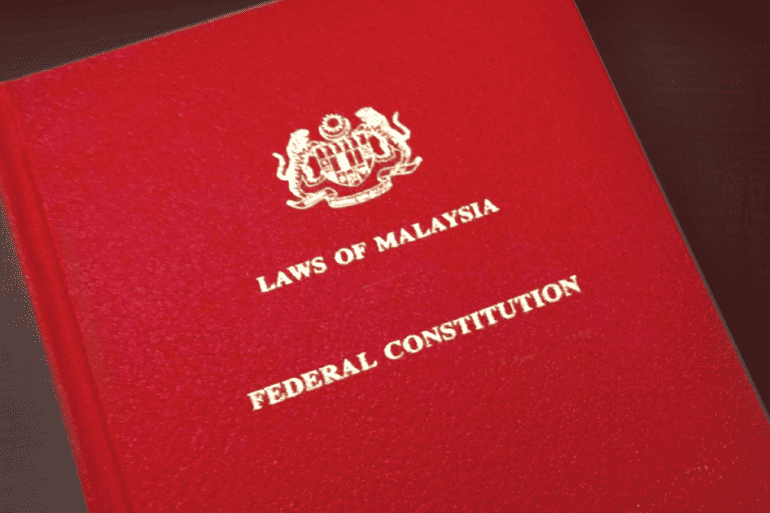
Open the Federal Constitution today. Turn to Part IX, which is headed THE JUDICIARY.
Above Article 121 there is a marginal note. It has been printed there since 1963, and no Act has ever removed it.
It reads: Judicial power of the Federation.
The heading is still there. Underneath it, there is none.
Next: Chapter 9 — Ashes and silence.
Further reading. The Report of the Panel of Eminent Persons to Review the 1988 Judicial Crisis in Malaysia (2008) is published in full, free, by the Malaysian Bar. The Federal Constitution is free to download from the Attorney General’s Chambers. Read the Notes at the back. They record every amendment ever made, and the day each one took effect.
∞§∞
This article is written for a general readership and does not constitute technical or legal advice. Readers with legal questions are encouraged to seek independent legal advice.
The author thanks KN Geetha, TP Vaani, JN Lheela, and Lydia Jaynthi at GK Legal. Our gratitude to New Straits Times for the image.
Claude, Anthropic’s AI, smoothed the drafting; Perplexity Pro checked the facts. The argument, the views, and the errors remain the author’s.
@Copyright reserved.
All content on this site, including but not limited to text, compilation, graphics, documents, and layouts, is the intellectual property of GK Ganesan Kasinathan and is protected by local and international copyright laws. Any use shall be invalid unless written permission is obtained by writing to gk@gkganesan.com.”