The machine: How does the NS State Constitution actually work? [2/NS]
How the 1959 constitution actually works: the composite Ruler, the four electors, and the clause built to silence courts.
The bottom line
Negeri Sembilan has a written constitution, enacted in 1959, sitting on top of ancient custom. Where the two collide, the written constitution wins. The “Ruler” of the state is not one man but a composite — the Yang di-Pertuan Besar together with his ruling chiefs — and the most important acts need the ruler plus at least three of the four Undang. This essay walks the machine, lever by lever. One thing to watch: the press and the parties keep saying the power to remove an Undang lives in “Article 14(3)”. The official text says something more careful. We flag that gap; we do not resolve it.
A constitution that swallowed a custom
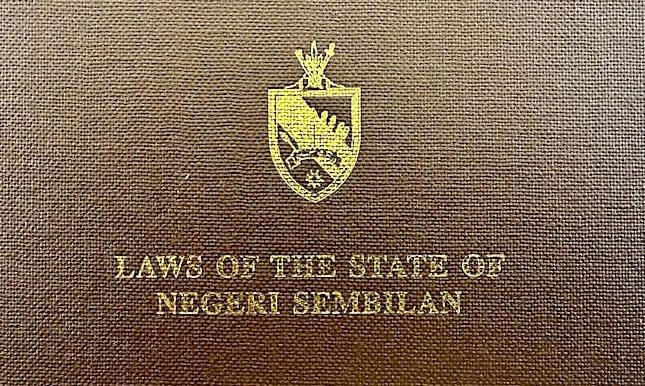
The first essay left us with a single strange fact: in Negeri Sembilan, ancient custom and modern written law share one house. The document that made that arrangement formal is the Laws of the Constitution of Negeri Sembilan 1959. It is a real constitution — two parts, around seventeen chapters, some eighty-odd articles — and it is the operative law of the state, reprinted with the ruler’s consent and incorporating amendments down to 1 January 2008.1 Laws of the Constitution of Negeri Sembilan 1959 (2008 Reprint, incorporating amendments to 1 January 2008), printed pursuant to Article LXXVIIIA (78A). The Reprint runs to two Parts and around eighty-one Articles.
A small but useful point about numbers. The authoritative English text uses Roman numerals — Article VII, Article X, Article XIV, Article XVI. Newer Malay-language versions, and most newspapers, use Arabic numerals — Article 7, 10, 14, 16. They are the same provisions. In this series we give both, like this: Article XVI (Article 16).2 The Roman numbering is the form used in the enacted English text and reproduced in Dato Menteri Othman bin Baginda v Dato Ombi Syed Alwi bin Syed Idrus [1981] 1 MLJ 29; Arabic numbering appears in the later Malay reprint. VII=7, X=10, XIV=14, XVI=16, XXVIII=28, XXIX=29, XXXII=32. If that seems fussy, wait: by the end of this essay you will see why getting an article number exactly right is not pedantry but the whole game.
Now to the levers.
Lever one: the Ruler is a committee
Start with the word “Ruler”, because it does not mean what an outsider assumes.
In ordinary speech, the ruler is the man on the throne. In the Negeri Sembilan constitution, Article XXVIII (Article 28) treats the “Ruler” as a composite — the Yang di-Pertuan Besar together with the ruling chiefs.3 Laws of the Constitution of Negeri Sembilan 1959 (2008 Reprint), Article XXVIII; the composite character of the “Ruler” is discussed in commentary on the 2026 dispute, e.g. Hishamudin Yunus, The Edge, 22 April 2026. For a range of functions under the state constitution, it is not enough for the man on the throne to act alone; the ruler and at least three of the four Undang must act together. The throne, in other words, is not a chair. It is a table — and several people have to be sitting at it.
This is the constitutional echo of the history. A state that elects its ruler keeps the electors close to the rulership itself. The man is the ruler; the table is the Ruler.
Lever two: the four electors
Article VII (Article 7) makes the election explicit. The Yang di-Pertuan Besar “shall be such person as shall be elected by the Undangs of the territories of Sungai Ujong, Jelebu, Johol and Rembau”, in the manner the constitution provides and in accordance with the custom of the state.4 Laws of the Constitution of Negeri Sembilan 1959 (2008 Reprint), Article VII(2). Article VII(3) sets the qualifications: a male of the Malay race, of sound mind, professing the religion of the state, and a lawfully-begotten descendant in the male line of Raja Radin ibni Raja Lenggang. The candidate must be a Malay Muslim man of sound mind, descended in the male line from a named ancestor; and on the death of a ruler the Undang choose a successor from a defined set of relatives, in a stated order.5 Laws of the Constitution of Negeri Sembilan 1959 (2008 Reprint), Article VII(4).
Two features matter for later. The choice is genuinely the Undang’s; and the eligible field is narrow and royal. Election here does not mean a free pick from the population — it means the four chiefs choosing among a small, qualified, royal line. It is an election within a family.
Lever three: moving against the man on the throne
This is the lever at the centre of the storm, so handle it with clean hands.
Article X (Article 10) allows the Undang, on stated grounds, to require the Yang di-Pertuan Besar to step back or step down. The grounds are not trivial. Commentators reproduce them: a “great and serious defect” such as insanity, blindness or dumbness; a “base quality” incompatible with the office under religious law; an “overt act detrimental to the sanctity, honour and dignity” of the ruler; or a deliberate disregard of the constitution itself.6 Grounds reproduced from Article X(1) by Malik Imtiaz Sarwar, Free Malaysia Today, 23 April 2026, and Hishamudin Yunus, The Edge, 22 April 2026; confirm against Laws of the Constitution of Negeri Sembilan 1959 (2008 Reprint), Article X. And the power may be used only “after full and complete enquiry by the Undangs”.7 Hishamudin Yunus, The Edge, 22 April 2026, citing Article X(1) (“full and complete enquiry”).
Two guardrails sit on this lever, and both are doing work in the present dispute.
The first is that phrase — “full and complete enquiry”. The constitution does not permit accusation followed by removal. It requires a process. What kind of process, and whether one was held, is exactly the sort of thing a court is built to examine — but that is a question for the essays ahead, not for this one.
The second is the proviso to Article X(2): a proclamation made under this power is, on the commentators’ reading, unenforceable unless it is issued jointly by the Undangs and the Menteri Besar — the head of the elected state government.8 Hishamudin Yunus, The Edge, 22 April 2026: the proclamation is legally unenforceable unless and until issued jointly by the Undangs and the Menteri Besar, under the proviso to Article X(2). In plain terms: the chiefs cannot do it by themselves. The elected government has to put its name to it. As matters stand, the Menteri Besar has not signed.9 Public reporting in 2026 records that the Menteri Besar declined to join in a proclamation; see Hishamudin Yunus, The Edge, 22 April 2026. We state that as a fact and pass on.
Lever four: the chiefs themselves
If the ruler can be moved against, what about the Undang who do the moving — how does a man become, or cease to be, one of the four?
Article XIV (Article 14) is the home of the ruling chiefs. Clause (1) is short and decisive: the Undangs of the four territories “shall be persons lawfully elected in accordance with the custom of their respective Luaks.”10 Laws of the Constitution of Negeri Sembilan 1959 (2008 Reprint), Article XIV(1), verified against the official Reprint, page 21. An Undang, that is, is made by luak custom — by the kind of clan procedure Caldecott described. And he is unmade the same way: the constitution speaks of an Undang “being removed from office in accordance with the custom of his Luak.”11 Laws of the Constitution of Negeri Sembilan 1959 (2008 Reprint), Article XIV(3), page 21. Removal of a chief, in other words, is a customary act, performed within his own district by his own people.
And here we must stop and be exact, because this is where the public conversation has slipped.
The “14(3)” puzzle — flagged, not resolved
Throughout 2026 the parties and the press have located the power to remove an Undang in “Article 14(3)”.12 See e.g. The Star, “Four Undang dispute MB’s claim over Mubarak’s removal”, 20 April 2026 (referring to Article 14(3)); the Lembaga Adat Sungei Ujong statement reported by Bernama, 5 May 2026, refers to removal “mengikut adat luaknya … selaras dengan … Fasal 14 (1 dan 3)”. On the face of the official 2008 Reprint, that is not quite what Article XIV(3) says.
Read in the Reprint, Article XIV(3) is an allowance clause. It provides that when an Undang vacates or is “removed from office in accordance with the custom of his Luak”, he is to be paid a monthly allowance for life — not exceeding a quarter of his official allowance — which the Legislative Assembly fixes by resolution; with a proviso letting the Assembly withhold the money if the recipient acts against the interests of the state.13 Laws of the Constitution of Negeri Sembilan 1959 (2008 Reprint), Article XIV(3), page 21. The clause is, on its face, a pension provision; it presupposes a removal effected by luak custom and provides the money that follows. Article XIV(4) makes the allowance a charge on the Consolidated Fund. In other words, XIV(3) does not create a power to remove an Undang. It assumes that custom may remove him, and then deals with his pension.
So where, in the written text, does the removal live? The removal itself is a matter of luak custom (XIV(1) and the opening words of XIV(3)). The body that advises on whether a removal is valid is the council we meet next — under Article XVI, not Article XIV.
We are not going to declare the parties “wrong”. They may be using “14(3)” as a convenient shorthand; they may be working from a differently-numbered consolidation; the point may matter to the court, or it may not. What we can do, accurately and neutrally, is this: set out the official text, note that public usage points elsewhere, and leave the reconciliation open. It is one of the genuine puzzles this dispute throws up — and, as it happens, the kind of puzzle that decides cases. Spotting a question is not the same as deciding it.
Lever five: the council, and the clause built to silence the courts
Article XVI (Article 16) creates the Dewan Keadilan dan Undang — the DKU, “the Council of the Yang di-Pertuan Besar and the Ruling Chiefs”. Its job, in clause (1), is to advise on questions of Malay custom, expressly including questions about the “election or succession to or removal from or vacation of office” of the ruling chiefs.14 Laws of the Constitution of Negeri Sembilan 1959 (2008 Reprint), Article XVI(1), page 22. Clause (2) allows the Menteri Besar to refer such questions to the Dewan. This is the body that speaks to whether an Undang’s removal was good in custom. The advice on removing a chief lives here, in Article XVI — which is the textual reason the “14(3)” usage repays a second look.
Then comes clause (3), and the temperature changes. Article XVI(3) provides that the Dewan’s advice on such questions “shall be final and shall not be challenged or called in question in any court on any ground.”15 Laws of the Constitution of Negeri Sembilan 1959 (2008 Reprint), Article XVI(3), page 22. That is what lawyers call an ouster clause — a clause whose entire purpose is to shut the courthouse door.
It was not always there. When the Federal Court examined Article XVI in 1981, the article was a single advisory provision with no such bar; the court noted, pointedly, that the article carried no words that its validity “shall not be questioned in any court”.16 Dato Menteri Othman bin Baginda v Dato Ombi Syed Alwi bin Syed Idrus [1981] 1 MLJ 29, 36 (Salleh Abas FJ). The bar arrived afterwards. The official amendment table records that Article XVI was amended once, and once only: by a notification gazetted as W.K.N.S. 546/1982, in force from 29 July 1982 — barely a year after that 1981 decision.17 Laws of the Constitution of Negeri Sembilan 1959 (2008 Reprint), “List of Articles Amended”, page 56, which records Article XVI amended by W.K.N.S. 546/1982, in force 29-07-1982 — the sole amendment to that Article. The sequence is striking. A court observes that the article contains no bar to the courts; about a year later, the article is amended to insert exactly such a bar. The reader may form his own view of the sequence. Whether that 1982 clause can still do its job in 2026 is the subject of essay 5/NS, and we leave it there.
Lever six: counting heads, and the line between custom and constitution
Two last levers, quickly, because the essays ahead lean on them.
Article XXIX (Article 29) is a counting rule. The powers and duties of the Undangs are validly exercised if exercised by at least three of them (or as many as are living).18 Laws of the Constitution of Negeri Sembilan 1959 (2008 Reprint), Article XXIX; relied on in the 2026 dispute, see Hishamudin Yunus, The Edge, 22 April 2026. Coupled with the composite-Ruler rule in Article XXVIII, it means the great acts of the state need a quorum of chiefs. Three is the magic number. Remember it: in essay 4/NS the entire dispute will come down to whether the people in the room added up to three valid chiefs.
And Article XXXII (Article 32) draws the deepest line of all. The ancient constitution and custom of Negeri Sembilan continue — except as the written constitution provides, and only “where not inconsistent with” it.19 Laws of the Constitution of Negeri Sembilan 1959 (2008 Reprint), Article XXXII; rendered by Salleh Abas FJ in Dato Menteri Othman [1981] 1 MLJ 29 as: ancient custom continues so long as it is not inconsistent with the State Constitution. In plain English: custom runs the state, until custom and the written constitution disagree — at which point the written constitution wins. That single sentence is the hinge on which several of the hardest questions in this dispute will turn, because so much of what is in dispute is being done in the name of custom.
What this sets up
You now have the machine:20“Machine” is used deliberately rather than “machinery”. A machine is a single mechanism one can picture and operate, lever by lever; “machinery” denotes the collective apparatus of state. The first names the device; the second, the workings. This series keeps them distinct. a composite Ruler (XXVIII), elected by four chiefs (VII); a guarded power to move against the man on the throne (X); chiefs made and unmade by luak custom (XIV); a council that advises on custom and whose advice is, by a 1982 amendment, declared beyond the courts (XVI); a three-chief quorum (XXIX); and a master rule that the written constitution prevails over custom in conflict (XXXII).
The next four essays pull the levers in order. 3/NS asks who may lawfully remove the ruler, and how. 4/NS asks the prior question on which everything balances — whether a particular chief was still a chief at all. 5/NS asks whether the 1982 ouster clause can really keep the courts out. 6/NS asks what becomes of the government, and how far any of this is a matter the courts may touch.
Each essay sets out the rival readings and stops. The machine is now on the table. Watch which lever moves.
This is essay 2 of six in a linked series on the 2026 Negeri Sembilan constitutional dispute. It explains the constitutional structure; it does not take a position on the matters now before the courts.21 On commenting carefully while litigation is pending, see GK Ganesan, “Is the sub-judice rule dead?”, https://www.gkg.legal/is-the-sub-judice-rule-dead/ .
∞§∞
This article is written for a general readership and does not constitute technical or legal advice. Readers with legal questions are encouraged to seek independent legal advice.
The author thanks KN Geetha, TP Vaani, JN Lheela, and Lydia Jaynthi at GK Legal.
Claude, Anthropic’s AI, smoothed the drafting; Perplexity Pro checked the facts. Advocate, editor and sceptic together made one essay better than any could alone. The argument, the views, and the errors remain the author’s.
@Copyright reserved.
All content on this site, including but not limited to text, compilation, graphics, documents, and layouts, is the intellectual property of GK Ganesan Kasinathan and is protected by local and international copyright laws. Any use shall be invalid unless written permission is obtained by writing to gk@gkganesan.com.