Tirbunal Two [Part 7/11-The Malaysian Judiciary Then and Now]
Three of them apologised. Two refused. That is how the story is usually told. It is wrong in every part.
Chapter 7 of What the Judiciary Was and What It Has Become
[A record of the Malaysian Judiciary, before 1988 to now]
Three of them apologised. Two refused.
That is how the story is usually told. It is wrong in every part.
The panel
Chapter 6 ended on 22 July 1988. A borrowed bench had undone the order of 2 July.1Tun Dato Haji Mohamed Salleh bin Abas v Tan Sri Dato Abdul Hamid bin Omar & Ors [1988] 3 MLJ 149 (SC), 22 July 1988. Coram: Hashim Yeop A Sani and Harun SCJJ, Mohamed Yusoff, Gunn Chit Tuan and Anuar JJ. Verified on Lexis Advance, 8 August 2026. The order of 2 July is reproduced in an appendix at p 151.
Five judges stood suspended for making it. Tan Sri Wan Suleiman Pawan Teh and Datuk George Seah. Tan Sri Mohamed Azmi Kamaruddin, Tan Sri Eusoffe Abdoolcader and Tan Sri Wan Hamzah.
On 12 August, the King appointed a tribunal to inquire into them.
A tribunal is a panel appointed to investigate a judge and report. It is not a court. It cannot punish. It may recommend one of two things only. Remove him, or do not. There is nothing in between.2Panel of Eminent Persons, Report of the Panel of Eminent Persons to Review the 1988 Judicial Crisis in Malaysia (Malaysian Bar Council, International Bar Association, LAWASIA and Transparency International–Malaysia, 26 July 2008) (‘PEP Report’) para 18.7; H P Lee, ‘A Fragile Bastion Under Siege — The 1988 Convulsion in the Malaysian Judiciary’ (1990) 17 Melbourne University Law Review 386, 401, citing the report of the Second Tribunal at p 40.
Tan Sri Hashim Yeop Sani was to chair it. He had sat on the bench of 22 July. He had helped set aside the very order now under inquiry.
At the first sitting, on 29 August, counsel said the obvious. Ordinary members of the public might see “a real likelihood of bias.”3Report of the Second Tribunal, p 4, quoted in Lee (n 2) 408.
He withdrew.
That single act settled an argument in the other tribunal. Two months earlier the acting Lord President had refused to withdraw from the tribunal trying Tun Salleh Abas. The objections to Tan Sri Abdul Hamid Omar were far heavier. Hashim Yeop Sani did in a day what he would not do in six weeks.4Lee (n 2) 408.
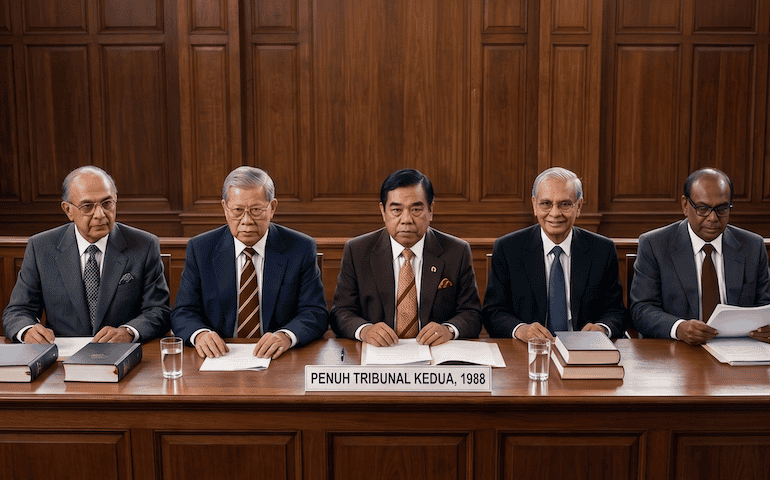
Datuk Edgar Joseph Jr took the chair. Nobody was added.
So five Supreme Court judges were tried by four High Court judges and one judge from Sri Lanka. No Chief Justice sat. The 2008 Panel of Eminent Persons needed six words for it. “It was a travesty of justice.”5PEP Report (n 2) para 18.8.
George Seah later reached for soldiers’ language. The Malayan Law Journal published a seniority list of the High Court’s judges. Of twenty-six, Edgar Joseph Jr stood thirteenth. Mohd Eusoff Chin stood fourteenth. Lamin Mohd Yunus stood twenty-fifth. Colonels, said Seah, had been appointed to judge generals.6George Seah, ‘1988 Judicial Crisis: Colonels Judging the Generals?’ Malaysiakini (15 September 2006).
What each man was actually charged with
Here is the charge sheet. So far as this series can find, it has never been set out in public judge by judge.
Against all five, first charge. That they intentionally attended the sitting of 2 July 1988. That they did so “without the permission or knowledge of the Acting Lord President.” Against Wan Suleiman the wording differed by three words. He was charged with “intentionally convening and being present” at it.
This was said to breach sections 38(1) and 39(1) of the Courts of Judicature Act 1964. Such conduct, the charge went on, reflected “an irresponsible and improper attitude.” It tarnished the image of the judiciary. It was unbecoming of a Supreme Court judge.7Report of the Second Tribunal, p 71, quoted in Lee (n 2) 408. Section 38(1) required every Supreme Court proceeding to be heard by three judges, or such greater uneven number as the Lord President determined. Section 39(1) provided that the court should sit on such dates and at such places as the Lord President appointed.
Against all five, second charge. That they intentionally heard the application on 2 July. The same matter was still before Ajaib Singh J in the High Court. This, it was said, showed a lack of impartiality and was unbecoming of a judge.8Report of the Second Tribunal, p 62, quoted in Lee (n 2) 409.
Against Wan Suleiman, two further charges. That he stayed away from the Kota Bharu sitting of 2 July without reasonable cause. And that he directed George Seah and Harun Hashim to leave it, without proper and reasonable cause.9Report of the Second Tribunal, pp 77–78, quoted in Lee (n 2) 409.
Against George Seah, one further charge. That he stayed away from the Kota Bharu sitting.10ibid.
That is the whole of it.
Now read the list again for what is missing. Against Azmi, Abdoolcader and Wan Hamzah there was nothing beyond the two charges everyone faced. Nothing personal. Nothing separate. Two charges each, and no more.
Both shared charges failed
The tribunal held the first charge not made out.
To prove misbehaviour it required proof of an improper motive. It also required proof beyond reasonable doubt. That is the criminal standard, the one that resolves a doubt in favour of the accused.
The evidence showed the opposite of a motive. The five had acted in the honest belief that Wan Suleiman could convene the sitting. And that the others could attend it.11Report of the Second Tribunal, p 74, quoted in Lee (n 2) 408.
The second charge it dismissed in two words. “Clearly unsustainable.”12Report of the Second Tribunal, p 70, quoted in Lee (n 2) 409.
All five were acquitted on both.
Azmi, Abdoolcader and Wan Hamzah returned to the bench because they had answered every charge against them and won. Not because they said sorry.
One qualification belongs in the record, because it is in the report. Two members added a note. Had the standard been the lower civil one, they would have found against Abdoolcader and Azmi. That standard is the balance of probabilities. It asks only what is more likely than not.13Report of the Second Tribunal, p 74, quoted in Lee (n 2) 408 n 3.
They did not apply it. The standard was the higher one, and they said so.
The apology that was never made
The apology story has a source. The source destroys it.
Before the hearing began, an approach was made to all five. They were to admit they had been wrong to sit on 2 July without the acting Lord President’s leave. They were to apologise to him.
All five refused. George Seah recorded it eighteen years later. He also named the angriest man in the room.
“As a matter of fact, the late Abdoolcader was furious with such a preposterous idea as all the five judges of the Supreme Court were of the same opinion that Wan Sulaiman had acted correctly and properly pursuant to section 9(1). When you have committed no wrong and your conduct is in keeping with the law, where is the justification for pleading guilty and apologising?”14George Seah (n 6). Datuk George Seah died in 2010.
Nobody apologised. There is no record that anybody did.
The seal, again
Chapter 6 left a Senior Assistant Registrar pressing the court’s seal onto an order. Her name was Soo Ai Lin. The registry had been told to have nothing to do with it.
The tribunal came back to that seal.
The representation to the King is the formal request for a judge’s removal. This one was made by the acting Lord President. It said that the five judges “took the seal from the registry even though the office was closed and the officers had gone home.”
The tribunal found that he “was without doubt misinformed.” None of the five had taken anything.
It also recorded what he had in fact instructed. That the courtrooms be kept closed. That the staff not assist at any such sitting. That the court seal not be made available.15Report of the Second Tribunal, pp 67 and 72, quoted in Lee (n 2) 413 and n 35.
The word “conspiracy” had appeared in the first English translation of the representation. Its accuracy was queried and a second translation produced. The tribunal then found there had been no conspiracy, and no prior agreement of any kind.16Report of the Second Tribunal, pp 55 and 60, quoted in Lee (n 2) 413.
So the document that removed two Supreme Court judges carried three defects. A mistranslation. An inference the tribunal rejected. And a fact the tribunal held to be untrue.
No action was ever taken against whoever supplied it.17Seah (n 6).
The two who were removed
Wan Suleiman was convicted on his two extra charges, unanimously. Removal was recommended by a majority. One member said removal was not justified.18Report of the Second Tribunal, pp 120 and 122, cited in Lee (n 2) 409.
One detail from the evidence deserves to survive.
On the morning of 2 July, before the sitting, Wan Suleiman sent for the Chief Registrar. He said he knew what the consequences would be. He said he was willing to be suspended for it.19Report of the Second Tribunal, p 113, cited in Lee (n 2) 410.
That was offered against him.
George Seah was convicted on his one extra charge by four of the five. Three recommended removal. The dissenting member wrote a sentence that answers the whole case. If it was proper for Seah to attend in Kuala Lumpur, his absence from Kota Bharu cannot have been improper.20Report of the Second Tribunal, p 133, quoted in Lee (n 2) 412 n 30.
The member who opposed removing Wan Suleiman listed his reasons. A single isolated incident. No miscarriage of justice. No partisanship. A long record of unquestioned integrity, and this the first blemish. A capacity to judge in future that remained unimpaired. No precedent anywhere for removal on such facts.21Report of the Second Tribunal, p 137, quoted in Lee (n 2) 413.
The majority recommended that both men keep their full pensions.22Report of the Second Tribunal, pp 122 and 132, cited in Lee (n 2) 409 nn 8 and 10.
On 4 October 1988 the King ordered the two of them dismissed. He acted, as the Constitution requires, on the recommendation before him. The other three went back to work.23Lee (n 2) 399. Under the Federal Constitution the Yang di-Pertuan Agong acts on advice.
A note on the citation
Anyone wishing to check the report must be warned.
The 2008 Panel gives its citation twice, and differently. Once as “[1989] 1 MLJ, 14 April 1989 Reports pp. 393-456.” Once as “[1989] 1 MLJ at pages.393 to 520.”24PEP Report (n 2) paras 6.6 and 18.9.
Neither works. [1989] 1 MLJ 393 is Re Sanpete Builders (S) Pte Ltd v Arab Malaysian Finance Berhad. It is a Singapore winding-up case, decided on 5 January 1989. It has nothing to do with any of this.25Checked on Lexis Advance, 8 August 2026.
The report was reproduced in the front section of the Malayan Law Journal. That section is numbered separately, in Roman numerals. The correct reference is [1989] 1 MLJ lxxxix.
The Panel’s own pages confirm it. Elsewhere the Report cites an annexure at “page cxxix.” Roman again, forty pages on.26Andrew Harding, Law, Government and the Constitution in Malaysia (Malayan Law Journal 1996), bibliography, giving Report of the Tribunal Established under Article 125(3) and (4) of the Federal Constitution Re YA Tan Sri Wan Suleiman bin Pawan Teh, Supreme Court Judge (Government Printer 1988), reproduced at [1989] 1 MLJ lxxxix; PEP Report (n 2) para 2.73. A limit on this chapter, stated plainly. The printed report has not been read directly by this series. Its pagination and its words are taken from Lee (n 2), who wrote in 1990 with the volume before him, and whose pinpoints are to the report’s own pages. Where the charges are quoted above, they are quoted from him.
Kelantan, 1989
All five had missed a sitting at Kota Bharu. That was the offence.
The following year the Sultan of Kelantan held an investiture. Sultan Ismail Petra honoured Param Cumaraswamy, then President of the Malaysian Bar, for his part in the crisis. He honoured Tan Sri Eusoffe Abdoolcader too.
A photograph survives from that day. Param stands with Datuk Seri George Seah, Tan Sri Wan Suleiman Pawan Teh and Tan Sri Mohamed Azmi Kamaruddin.27Steven Thiru and David Dinesh Mathew, ‘Citation for Param Cumaraswamy: Malaysian Bar Lifetime Achievement Award 2018’ in Malaysian Bar Lifetime Achievement Award 2018 (Malaysian Bar 2018) 8, and the photographs and captions reproduced there.
Two of the men in it were no longer judges.
Next: Chapter 8 — the amendment.
Further reading. The Report of the Panel of Eminent Persons to Review the 1988 Judicial Crisis in Malaysia (2008) is published in full, free, by the Malaysian Bar. H P Lee’s ‘A Fragile Bastion Under Siege’ (1990) 17 Melbourne University Law Review 386 is free on AustLII. It remains the closest published reading of the second tribunal’s report.
∞§∞
This article is written for a general readership and does not constitute technical or legal advice. Readers with legal questions are encouraged to seek independent legal advice.
The author thanks KN Geetha, TP Vaani, JN Lheela, and Lydia Jaynthi at GK Legal. Our gratitude to Gemini for the Ai generated image.
Claude, Anthropic’s AI, smoothed the drafting; Perplexity Pro checked the facts. The argument, the views, and the errors remain the author’s.
@Copyright reserved.
All content on this site, including but not limited to text, compilation, graphics, documents, and layouts, is the intellectual property of GK Ganesan Kasinathan and is protected by local and international copyright laws. Any use shall be invalid unless written permission is obtained by writing to gk@gkganesan.com.”