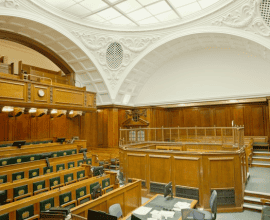
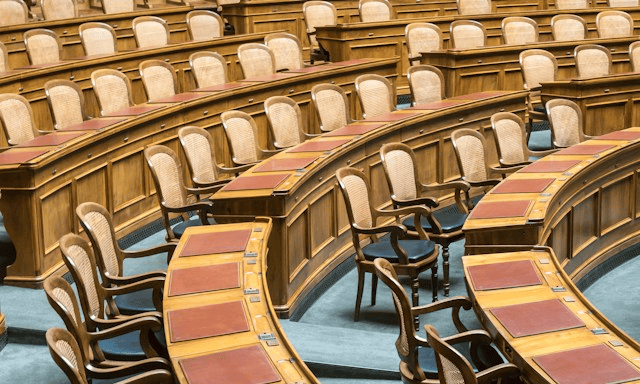
What can happen when Negeri Sembilan’s Assembly sits on 16 October? [19/NS]
The Ruler will open it. The Speaker will run it. Between those two facts sits a question no Malaysian court has yet had to answer.
On 16 October, the Legislative Assembly of Negeri Sembilan sits again.
The Yang di-Pertuan Besar, Tuanku Muhriz, is to open it.1Speaker Awaludin Said, reported 14 September 2026 (Malay Mail; The Star; The Vibes): the sitting is “scheduled for October 16” and will be “officially opened by the Yang di-Pertuan Besar of Negeri Sembilan Tuanku Muhriz.”
That single fact settles less than it looks like it settles. This essay maps what the law allows once the House is in session, and where the map runs out.
It takes no side on any dispute now before a court. It states only the machinery.
WHO CALLS THE HOUSE TO ORDER
Every Malaysian state constitution carries the same clause. Negeri Sembilan’s is Article LVI.
The Ruler summons the Legislative Assembly. No more than six months may pass between one sitting and the next.2Laws of the Constitution of Negeri Sembilan, 1959 (Reprint 1979, G.N. 214/1959), Art LVI(1): “The Ruler shall from time to time summon the Legislative Assembly and shall not allow six months to elapse between the last sitting in one session and the date appointed for its first sitting in the next session.” Exact wording confirmed directly against CLJLaw’s Reprint text this session (27 September 2026), paralleling Federal Constitution Art 55 and the Eighth Schedule, Part I template every state constitution must follow.
Summoning is not on the short list of matters the Ruler may do alone. Article XL(2) names only two: appointing a Menteri Besar, and refusing a request to dissolve.3Laws of the Constitution of Negeri Sembilan 1959, Art XL(1A), (2).
So summoning, like almost everything else, runs on advice.
A reader following this series will ask the obvious question. If the government and the palace cannot agree on who the Ruler even is, whose summons calls the House?
Here, that fight has not reached the calendar. The Speaker himself has said the sitting proceeds, opened by Tuanku Muhriz.4Above, n 1. Whatever else is contested, that point, for now, is not.
WHAT MIGHT HAPPEN ON THE FLOOR
The motion that has not been filed
On 14 September the Speaker said plainly that no motion of no confidence had reached him.
He added something sharper. Even an emergency motion, he said, would not be allowed.5Speaker Awaludin Said, above, n 1.
What a proper notice would need
Every Malaysian legislature runs its motions through its own Standing Orders, and Negeri Sembilan’s have not been traced to a public text this session.
That gap is stated here rather than filled with a guess. What can be said is the shape common to these documents elsewhere in Malaysia: a member gives written notice, the Speaker settles the order of business, and an emergency motion is admitted only at the Speaker’s discretion, for a matter of real urgency.6This paragraph describes the common structure of Malaysian legislative Standing Orders generally, illustrated by the Dewan Rakyat’s own rules; it does not state a notice period for Negeri Sembilan specifically, which remains to be confirmed against Negeri Sembilan’s own Standing Orders (Peraturan-Peraturan Majlis Mesyuarat).
If that structure holds here, the Speaker’s discretion is real. But it is not unlimited, as the next section shows.
THE SHIELD AROUND THE HOUSE
Article 72(1) of the Federal Constitution says a court may not question the validity of proceedings in a State Assembly.
Read alone, that looks like a wall nothing can cross.
It is not read alone. In 2009 the Federal Court reviewed the Perak Speaker’s own conduct, and struck it down.7YAB Dato’ Dr Zambry bin Abd Kadir & Ors v YB Sivakumar a/l Varatharaju Naidu (Attorney General Malaysia, Intervener) [2009] 4 MLJ 24; [2009] 4 CLJ 253 (FC, 3 June 2009) — MLJ citation confirmed on Lexis Advance and CLJ citation confirmed directly on CLJLaw this session.
The reasoning has since hardened into a rule. The Assembly, and its Speaker, must act within their constitutional and legal powers before Article 72(1) can even begin to apply.8Dewan Undangan Negeri Selangor & Ors v Mohd Hafarizam bin Harun [2016] 4 MLJ 661; [2016] 7 CLJ 143 (FC, 14 July 2016) — MLJ citation confirmed on Lexis Advance and CLJ citation confirmed directly on CLJLaw this session.
Act squarely within an express power, though, and the shield holds. A later case confirms that much.9Teng Chang Khim (appealing as Speaker of Selangor State Legislative Assembly) v Badrul Hisham bin Abdullah & Anor [2017] 5 MLJ 567; [2017] 9 CLJ 630 (FC, 28 August 2017) — MLJ citation confirmed on Lexis Advance and CLJ citation confirmed directly on CLJLaw this session.
So the live question, if it ever comes to that, is narrow but real. Does refusing a properly noticed motion sit inside the Speaker’s express powers, or outside them?
No Malaysian court has yet answered that exact question. This essay does not answer it either.
A HOUSE THAT SPLIT IN TWO
Malaysia has already seen what happens when an Assembly’s own legality is fought over on the ground, not just in the law reports.
In March 2009, with two men each claiming to be Perak’s Speaker, one faction of the Assembly met under a rain tree outside the state building, because the hall itself was barred to them.10The “Democracy Tree” sitting of the Perak Legislative Assembly, 3 March 2009 — press and historical record; illustration only, not itself the subject of any reported holding.
Nothing in Negeri Sembilan’s papers points toward that scene repeating on 16 October. It is set out here for one reason only.
It shows a truth this series keeps returning to. A constitution’s machinery can jam even while every clause on the page reads perfectly clearly.
WHAT THIS LEAVES OPEN
Three things could happen on 16 October, and the Constitution allows for all three.
The sitting could pass without incident, business as usual under a Speaker keeping firm control of his own order paper.
A motion could be filed and admitted, testing the numbers on the floor for the first time since April.
Or a motion could be filed and refused, moving today’s open legal question from a footnote into a live dispute.
Whichever door opens, one thing about a State Assembly’s own inner life will remain true, whatever else is contested outside it. Its Speaker’s word, until a court says otherwise, still carries the House.
∞§∞
This article is for general information only and is not legal or technical advice. Seek independent legal advice where appropriate.
Thanks to KN Geetha, TP Vaani, JN Lheela and Lydia Jaynthi of GK Legal, and Hansjorg Keller of Unsplash for the image. Claude (Anthropic) assisted with drafting and Perplexity Pro with fact-checking; the author is solely responsible for all views and errors.
© GK Ganesan Kasinathan. All rights reserved. No part of this site’s content may be used without prior written permission: gk@gkganesan.com.