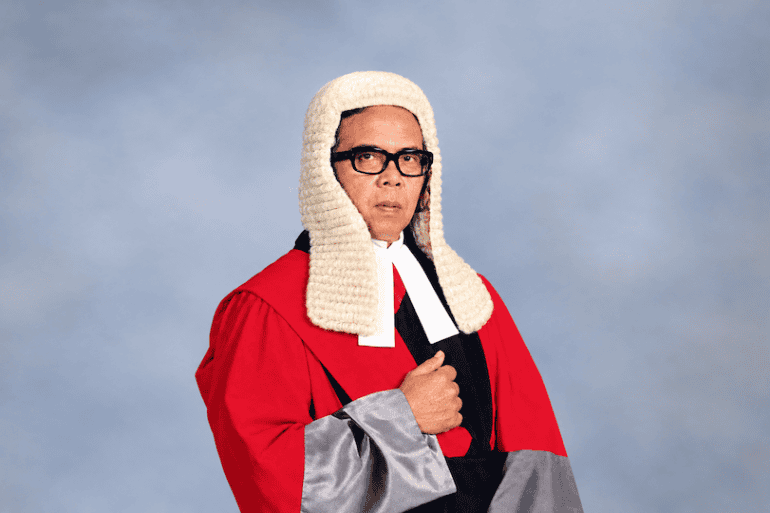
Can Three Sentences Run a Whole Country? The Broadcaster on the Bench: Tun Suffian
A wartime newsreader became Lord President — and three of his sentences still decide Malaysian cases today.
How Tun Mohamed Suffian, wartime BBC newsreader turned Lord President, wrote the three-sentence doctrine of constitutional supremacy that Malaysian courts still apply today.
Picture a young Malay newsreader in wartime London
He is reading the evening bulletin into the dark. The Japanese have overrun his homeland, and there is no going home.
There is also no second take. If a sentence runs too long — too clever, too larded with subordinate clauses — the listener in Kuala Kangsar, hearing it once, through static, in the middle of a war, simply loses it.
The bulletin moves on, and the sentence is gone for good. Three years of that discipline, first at All India Radio in Delhi and then at the BBC’s Malay Section in London, taught Mohamed Suffian bin Mohamed Hashim what no law lecture could: how to say a complicated thing exactly once, and be understood the first time.
He said so himself, in later life — the radio years, he believed, were excellent training for the bench, teaching him “to write and speak clearly, briefly and to the point”.1Tun Mohamed Suffian Hashim, biographical memoir; see also ‘Tun Mohamed Suffian’, The Daily Telegraph (London), obituary, 2000.
Ask whose judicial style Tun Suffian followed, then, and the honest answer is: no judge at all. He followed a microphone.
From a Kampong on the Perak River
Suffian was born on 12 November 1917 in Kota Lama Kiri, a village on the Perak River near Kuala Kangsar, the second of fourteen children of a village kadi.
He became the first pupil from a rural Malay school to win a Queen’s Scholarship, which carried him to Gonville and Caius College, Cambridge, and to the Bar at the Middle Temple in 1941.
He was on his way home when the invasion of Malaya stranded him — first in India, then in that London radio booth.2‘Tun Mohamed Suffian’, The Daily Telegraph (London), obituary, 2000.
Back in Malaya in 1948, he was appointed magistrate of Malacca — and, there being no separate budget for his salary, harbour master as well.3ibid.
One likes to imagine the ships waiting patiently for judgment to be delivered. From there he rose through Deputy Public Prosecutor, Solicitor-General and the High Court bench, becoming Chief Justice of Malaya in 1973 and, in 1974, the fourth Lord President of the Federal Court — an office he held for 3,118 days, still the longest tenure in the nation’s history.4‘Chief Justices of Malaysia’, From the Bar Stool, 19 January 2024.
He retired in 1982 and died on 26 September 2000, aged eighty-two.
By the Sultan of Perak’s own mark of respect, he was buried in the Royal Mausoleum at Kuala Kangsar — a few miles from the kampong where he began.5‘Tun Mohamed Suffian’, The Daily Telegraph (London), obituary, 2000.
Three Sentences That Still Run the Country
If Edgar Joseph Jr’s genius was to expand a tangled doctrine into a numbered checklist, Suffian’s was the opposite: to compress an entire constitutional order into as few words as a radio bulletin would allow.
The masterpiece is Ah Thian v Government of Malaysia, where, in three unadorned sentences, he laid down the whole architecture of Malaysian constitutionalism: “The doctrine of the supremacy of Parliament does not apply in Malaysia. Here we have a written constitution. The power of Parliament and of State legislatures in Malaysia is limited by the Constitution, and they cannot make any law they please.”6Ah Thian v Government of Malaysia [1976] 2 MLJ 112 (FC), per Suffian LP.
Read those three sentences aloud. Not one clause needs a second hearing. A bus conductor could repeat them; a Federal Court panel could build on them; both, it turns out, have. And the same judgment then does something the three sentences alone do not reveal.
A few paragraphs on, Suffian sets out, with numbered precision, the three ways a Malaysian law can fail: made outside the legislature’s power under Article 74; inconsistent with the Constitution under Article 4(1); or, for a State law, inconsistent with federal law under Article 75.7ibid.
The broadcaster wrote for the man in the street; the Chancery draftsman, in the same judgment, wrote for the profession. He did not choose between his audiences. He served both in a single page.
Fifty years on, the three sentences are still doing the heaviest lifting in Malaysian constitutional law. The Federal Court reached for Suffian LP in 2024 when it struck down sixteen Kelantan Syariah criminal provisions as beyond the State’s power.8Nik Elin Zurina bt Nik Abdul Rashid & Anor v Kerajaan Negeri Kelantan (Federal Court, 9 February 2024), majority judgment, citing Ah Thian v Government of Malaysia [1976] 2 MLJ 112.
The Chief Justice built an address to an international legal conference around them, to explain why Malaysia is not Britain and Parliament here is not sovereign.9Tun Tengku Maimun Tuan Mat, Address to the 38th LAWASIA Conference, published by the Malaysian Bar.
And the courts were still opening from Ah Thian in 2026, in testing whether the word “annoy” in the Communications and Multimedia Act can survive the Constitution.10Government of Malaysia v Heidy Quah, reported at elaw.my, [2026] JE 9.
A doctrine a broadcaster could deliver in a single breath has outlived him by half a century.
Certified in Print, While He Was Still Sitting
Every tribute repeats, almost as folk wisdom, that Suffian wrote for the ordinary Malaysian.
What is rarely quoted is the moment a serious academic said so in print, in real time, with no reason to flatter him.
Reviewing the second edition of his textbook, An Introduction to the Constitution of Malaysia, in the Malaya Law Review in 1976, S Jayakumar noted that the book was already “quoted with approval, if not authority, in the Courts of Malaysia”, and found it unique in serving “numerous categories of readers, from ‘the man in the street’ right up to the learned judges themselves”.11S Jayakumar, book review of Tun Mohamed Suffian, An Introduction to the Constitution of Malaysia (2nd edn), (1976) 18 Malaya Law Review 365.
Not a eulogy, written kindly after his death.
A contemporary verdict, delivered while he sat — that his prose genuinely worked on two audiences at once, which is precisely the trick a good radio bulletin must pull off.
The same review preserves something better still. In the first edition, Suffian had written that in the last resort Parliament was supreme. By the second edition he had thought again, and said so without a flicker of embarrassment: “I have changed my view and am now of the opinion that in Malaysia only the Constitution is supreme.”12ibid, comparing the first edition at p 79 with the second edition at p 97.
A sitting Lord President, in a book cited by his own courts, correcting himself in print.
The correction came a year before Ah Thian.
It then became the cornerstone of the constitutional order.
Few judges anywhere are that honest about their own intellectual history; fewer still have watched the honesty harden into doctrine.
No Savak Here
If Ah Thian shows the constitutional architect, Lai Kim Hon v Public Prosecutor shows the plain-spoken guardian of ordinary decency.13Lai Kim Hon & Ors v Public Prosecutor [1981] 1 MLJ 84 (FC).
Six police officers had tortured a sixteen-year-old frog-catcher, Nordin bin Hamzah, to death over some forty hours of interrogation — handcuffed to a window grille, beaten with a rubber hose in relays, denied food and water, all on suspicion of housebreaking.
When the case reached the Federal Court, Suffian LP did not reach for Latin. He reached for the most feared secret police of the age: “Parliament and the public will not allow a Savak to be established here.”14ibid. The Savak was the Shah of Iran’s secret police, disbanded after the 1979 revolution.
The police exist to protect the public, he said; but one power they do not have, and are never likely to be given, is the power to assault and torture suspects in their custody — and those who exceed their powers should not expect the law’s protection.15ibid.
A kampong boy’s son could hear that once, through static, and understand it the first time. That was rather the point of the man who wrote it.
The Referee, the Tyrant, and the Ouster Clause
Three more glimpses, each worth more to a working lawyer than any eulogy.
First, the referee. In 1988, at the height of the judicial crisis, Suffian wrote the foreword to Tun Salleh Abas’s book on judicial independence. He did not reach for Blackstone or Dicey. He reached for the football pitch:
“There can be no justice for the people without independent judges as there can be no game without independent referees.”
Assaulting the judiciary, he added, “is as crude and uncivilised as assaulting a referee” — and a nation that stands by while it happens “will in the end get a judiciary they deserve — one powerless to stand between them and tyranny”.16Tun Mohamed Suffian, foreword to Tun Salleh Abas, The Role of the Independent Judiciary (1988), 17 December 1988; quoted in ‘Judicial Independence is Sacrosanct’, The Malaysian Bar.
Every Malaysian who has ever shouted at a linesman understood him perfectly. That was the idea.
Second, the wit beneath the courtesy. During that same crisis he privately took to calling the prime minister of the day “Papa Doc”, after the Haitian dictator — while publicly, and by name, defending judicial independence against him. He never withdrew a word.17‘Tun Mohamed Suffian’, The Daily Telegraph (London), obituary, 2000.
Third, the ouster clause. In Re Tan Boon Liat @ Allen, detainees were held under emergency powers after the Advisory Board had failed to make its recommendations within the three months the Constitution allows.
The statute declared the Minister’s decision final, not to be called in question in any court. Suffian LP’s court reached across the Commonwealth for Anisminic, the House of Lords’ great ruling that such a clause protects only real decisions — not decisions made without the power to make them — and ordered the detainees released.18Re Tan Boon Liat @ Allen & Anor [1977] 2 MLJ 108 (FC), applying Anisminic Ltd v Foreign Compensation Commission [1969] 2 AC 147 (HL).
Anisminic was above all Lord Reid’s doing, and Reid’s is a name worth pausing over. He sat in the House of Lords for a quarter of a century, and the profession still speaks of him as the greatest British judge of his century — in the same breath as Sir Owen Dixon of Australia. Legal practitioners and law students, read Anisminic slowly. It repays the visit.
The Measure of the Man
He could rule against the citizen with the same rigour he used for the citizen. In the passport case, Loh Wai Kong, he held that “personal liberty” in Article 5 does not carry a constitutional right to travel abroad — but only after taking the Indian Supreme Court’s contrary authorities seriously enough to answer them.19Government of Malaysia & Ors v Loh Wai Kong [1979] 2 MLJ 33 (FC), per Suffian LP.
And he gave the multi-racial judiciary its finest one-sentence standard: judges should write so that “nobody reading our judgment with our name deleted could with confidence identify our race or religion”.20Tun Mohamed Suffian, address on the judiciary in a multi-racial society, delivered in Singapore; quoted in the biographical literature. Blind justice, stated without a single Latin word.
The author of these essays never appeared before him; by the time that chance might have come, Suffian had long retired to his books and his arbitrations.
There is no courtroom anecdote to tell, and that absence proves the broadcaster’s point better than any anecdote could.
His voice reached lawyers he never met, in courtrooms he never sat in, through sentences that could be heard once — through static, in the middle of a war, or across half a century — and understood the first time. The bulletin, it turns out, is still being broadcast.
The courts are still listening.
∞§∞
This article is written for a general readership and does not constitute technical or legal advice.
Readers with legal questions are encouraged to seek independent legal advice.
The author thanks KN Geetha, TP Vaani, JN Lheela, and Lydia Jaynthi at GK Legal.
Claude, Anthropic’s AI, smoothed the drafting; Perplexity Pro checked the facts. The argument, the views, and the errors remain the author’s.
@Copyright reserved. All content on this site, including but not limited to text, compilation, graphics, documents, and layouts, is the intellectual property of GK Ganesan Kasinathan and is protected by local and international copyright laws. Any use shall be invalid unless written permission is obtained by writing to gk@gkganesan.com.