
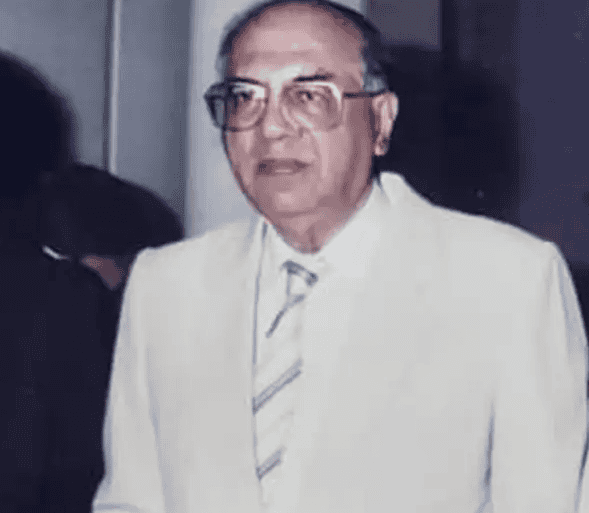
How Do You Turn Two Hours of Rambling Argument Into Forty Minutes of Justice? The Judging Genius of Edgar Joseph Jr
A two-hour submission, one raised hand, and forty minutes: how a Federal Court judge quietly rewrote Malaysian law.
The Seremban judge who made no apologies for acres of paper and streams of ink, and taught a young lawyer that talent needs a stage
It is the year 1992
The Supreme Court of Malaysia — not yet renamed the Federal Court — sits two hours into a submission that shows no sign of ending. Counsel for the appellant circles the same proposition from six different angles.
In the well of the court, a young lawyer waits beside his lead counsel, Gopal Sri Ram, for their own appeal to be called. There was no clock in those days, no allotted twenty minutes; an argument could run from ten in the morning to the next afternoon, and often did.
Then Edgar Joseph Jr SCJ, silent for two hours, raises a hand. “I apologise. May I please interpose?”
Counsel stops mid-sentence, utterly disarmed. In one breath, the judge recites back the proposition counsel has spent two hours failing to say plainly — precise, short, sharp, with just enough room left in it for counsel to build on.
“Do you think we have got it right? Would you wish to enhance it in any way?”
Counsel, dumbstruck, shakes his head.
“No? Splendid. Let us test it, then.”
Four quick questions later, pulling the proposition four different ways, he turns to the other side.
“How does that strike you? Any suggestions? Do you need more time?”
Respondent’s counsel, wisely, declines. A morning’s submission ends in forty minutes flat.
That is the whole of Tan Sri Edgar Joseph Jr FCJ, compressed into one afternoon. The instinct to take something sprawling, and reduce it, without cruelty, to its essential shape.
Who Was Edgar Joseph Jr?
Edgar Joseph Jr was educated at St Paul’s Institution, Seremban, and called to the Bar at Lincoln’s Inn in 1955. He joined his father’s law firm, practising commercial and criminal defence work through the 1970s and 80s. The High Court in Penang took him onto the bench in 1982; the Supreme Court, and then the Federal Court, held him until his retirement in 1999. He died on 28 June 2024, aged ninety.1‘Legal eagle Edgar Joseph Jr dies aged 90’, Free Malaysia Today, 30 June 2024.
Former Bar president Cyrus Das called him “one of the finest legal eagles in the apex court”, whose judgments “still stand as good law until today”.
Fellow senior counsel Bastian Pius Vendargon went further: “one of the greatest legal minds the nation has seen.”2ibid.
The Discipline of Compression
His judgments were never short. Yet the length was never padding. His method stayed constant: take a doctrine grown vague through years of loose use, and rebuild it as a small, numbered set of tests, each stated in one crisp defining sentence.
Picture a hedge left to itself for a decade, branches shooting in every direction, its original shape long forgotten. A topiarist arrives with shears, and by evening the hedge stands disciplined again — not smaller, only clearer, every stray branch accounted for and cut to purpose. That was his method with an unruly doctrine. Nothing removed that mattered; everything that blurred the shape, gone.
He did exactly this, still a judge of the High Court in Ipoh, hearing an application for leave to appeal in Pang Hon Chin v Nahar Singh.3Pang Hon Chin v Nahar Singh [1986] 2 MLJ 145 (HC, Ipoh), Edgar Joseph Jr J.
The application itself he dismissed in limine, as hopelessly out of time; counsel conceded as much with what the judge called “commendable candour”.4ibid, at 145-146.
But he added, in passing, “one or two general observations”: leave should turn on three things — a prima facie case of error, a question of general principle decided for the first time, or a question of importance on which further argument and a Federal Court decision would serve the public advantage.5ibid, at 146.
By his own account the observations were not strictly necessary; he confessed that, had the question actually arisen, he would have needed a great deal of persuading to grant leave at all.6ibid. None of that seemed to matter. Malaysian courts adopted the three limbs as though Parliament itself had drafted them. An aside, tossed off almost carelessly, hardened into doctrine. That, too, is what it means to reduce a mess to its essential shape: even the offcuts prove useful.
Rigour showed up again a few years later, turned this time on proof rather than doctrine. A Canadian buyer sued its Penang supplier for over US$700,000 in profits lost on twenty-six unfulfilled garment contracts.7Popular Industries Ltd v Eastern Garment Manufacturing Sdn Bhd [1989] 3 MLJ 360 (HC, Penang), Edgar Joseph Jr J.
Edgar Joseph Jr J found the sellers squarely in breach, and then turned to the damages claimed, where almost nothing survived his scrutiny. The buyer’s accountant had built his figures on the company’s own books of account; the books themselves were never tendered in evidence, so neither were the figures built on them.8ibid, at 368-369.
A plaintiff must actually prove its loss, he held; “it is not enough to write down the particulars, and so to speak, throw them at the head of the court”.9ibid, at 369, quoting Lord Goddard CJ in Bonham-Carter v Hyde Park Hotel Ltd, as approved by Thomson CJ in Lee Sau Kong v Leow Cheng Chiang [1961] MLJ 17. Of a claim for US$708,708.74, the plaintiffs recovered US$500 in nominal damages.10ibid. Sympathy for the wronged party never once tempted him into supplying evidence the party had simply failed to bring.
The Judge He Resembled
Whose style did he follow? Not Lord Denning’s, for all that Denning is the judge every young Commonwealth lawyer is taught to imitate. Denning opened with a story; Edgar Joseph Jr opened with the doctrine itself, and arrived faster. The true kinship lies with Lord Diplock, whose speech in the GCHQ case classified the whole of judicial review under three heads — illegality, irrationality, and procedural impropriety — each introduced with the same exacting formula.11Council of Civil Service Unions v Minister for the Civil Service [1985] AC 374 (HL).
Diplock sat in the House of Lords for nineteen years, and GCHQ remains required reading wherever the common law is taught. Ask a judge trained anywhere in the Commonwealth which single judgment gave modern judicial review its shape, and most will name this one without pausing to think. Law students, begin there; the whole architecture of the subject sits inside those three words.
Edgar Joseph Jr borrowed Diplock’s grammar, and then pushed further than Diplock himself had dared.
Judgments That Changed Ordinary Lives
In R Rama Chandran v The Industrial Court of Malaysia, he delivered the leading judgment for a Federal Court split two to one.12R Rama Chandran v The Industrial Court of Malaysia & Anor [1997] 1 MLJ 145; [1997] 1 CLJ 147 (FC), 20 July 1996; Eusoff Chin CJ and Edgar Joseph Jr FCJ in the majority, Wan Yahya FCJ dissenting. He worked through Diplock’s three heads in turn, then went where Diplock had only gestured — “Lord Diplock’s fourth ground of Judicial Review — namely, proportionality” — holding that English law itself had come to recognise it, and that it enables a court to review a decision “for substance as well as process”.13ibid, at 188H, per Edgar Joseph Jr FCJ.
Where England’s own courts still hesitated, Malaysia’s Federal Court took up the invitation.
The doctrine did something for the man on the street that Diplock’s own ruling in London never quite achieved.
Rama Chandran had been unemployed for seven years, dismissed unfairly, and the old rule would have sent his case back to the Industrial Court for yet another hearing — years more delay, for a man who had already waited seven. Edgar Joseph Jr’s court refused to remit. Assessing the compensation would “involve a simple arithmetical calculation”; to send it back “would seem to be a certain detachment from reality and, more importantly, it will not answer the needs of justice. We must, therefore, do what the Industrial Court should have done.”14ibid, at 198C and 198F, per Edgar Joseph Jr FCJ. The court did precisely that, ordering the employer to pay RM489,800.15ibid, at 148 and 185D–E, I. For every dismissed worker who has since won judicial review of an unfair tribunal decision, that ruling means the courts can simply pay them, rather than send them back to square one.
And he closed the judgment with a sentence that has travelled ever since: “In doing so, I trust that we have pointed the way to new horizons in the forward march of Judicial Review.”16ibid, at 198G. It was not a boast. It was a signpost — and the courts have been following it for nearly thirty years.
He could tighten the law as readily as he could extend it. In Arulpragasan Sandaraju v Public Prosecutor, sitting with six other Federal Court judges, he delivered the majority judgment on a question that decides the fate of every accused person in the country: what must the prosecution prove before an accused is even called upon to answer?17Arulpragasan Sandaraju v Public Prosecutor [1996] 4 CLJ 597 (FC). The answer, he held, is proof beyond reasonable doubt, not the lesser prima facie standard — a “maximum evaluation” of the evidence, not a minimal one.18ibid. Two of his brethren dissented; the majority prevailed. The net against wrongful conviction was drawn tighter for every accused person in the country, and it has stayed tightened since.
A Statute That Never Made a Promise
Land law brought out the same discipline, this time turned against loose thinking rather than in support of it. In Borneo Housing Mortgage Finance Bhd v Times Engineering Bhd, delivering the judgment of the Supreme Court, he was invited to find indefeasibility of title hidden somewhere inside the Sabah Land Ordinance — an Ordinance that had never once used the word.19Borneo Housing Mortgage Finance Bhd v Times Engineering Bhd [1996] 2 CLJ 561 (SC).
He declined the invitation outright. The Ordinance required registration before title could pass — that much the statute plainly said. But indefeasibility, the guarantee that a registered title can never later be unpicked, was a different promise altogether, and the Sabah legislature had simply never made it.20ibid. Lower courts, for years afterward, kept reading the missing promise back into the text anyway, out of habit, or hope, or both. The Court of Appeal was still correcting the error sixteen years later, quoting his judgment at length to do it.21Sia Hiong Tee & Ors v Chong Su Kong & Ors [2012] 1 LNS 1292 (CA), applying Borneo Housing Mortgage Finance Bhd, cited above. Judges write for their own case. The best of them write for every case that comes after.
A Porcupine of a Case
Compression was his instinct, never his only setting. Some cases refuse to be reduced, and a good judge knows the difference.
A Penang cooperative society set out to build flats for its own members, secured planning permission, and began selling units — some at RM60,000 apiece. Then, when the permission needed extending, the Municipal Council attached a new condition out of nowhere: thirty per cent of the units were now to be sold at RM25,000, and to members only.22Majlis Perbandaran Pulau Pinang v Syarikat Bekerjasama-sama Serbaguna Sungai Gelugor dengan Tanggungan [1999] 3 MLJ 1; [1999] 3 CLJ 65 (FC), Edgar Joseph Jr, Mohamed Dzaiddin FCJJ and Mokhtar Sidin JCA, 26 May 1999.
No advance notice. No hearing. No reasons given.
And, sitting in every Council meeting that touched the project, one councillor whose niece was a squatter on the very land — a councillor who had personally negotiated with the society for a three-bedroom flat on her behalf.23ibid, at 67-68 and 73.
The judgment holds the two halves of his method in perfect balance. The Council did have power to impose an affordable-housing condition; the Act and the Structure Plan gave it that much, and he said so plainly.24ibid, at 52-54. But a power lawfully held can still be unlawfully used.
Fairness demanded advance notice, and there was none; fairness demanded reasons, and none were given; the condition itself was out of all proportion to the extension sought.25ibid, at 60-61, 64 and 67. And the councillor’s personal interest disqualified him automatically, poisoning the decision at its root — the whole of it null and void.26ibid, at 67-68 and 75.
Along the way, almost casually, the judgment declined to follow the Privy Council itself, preferring Lord Denning’s view that no privative clause can stop the High Court correcting an inferior tribunal’s errors of law.27ibid, at 42-45, declining to follow South East Asia Fire Bricks Sdn Bhd v Non-Metallic Mineral Products Manufacturing Employees Union [1981] AC 363 (PC), and preferring Pearlman v Keepers and Governors of Harrow School [1979] QB 56 (CA).
The hearing had taken six days, over what he called “a veritable legal porcupine bristling with interesting and complex points of law”. Closing the unanimous judgment — seventy-nine reported pages of it — he made “no apologies for the acres of paper and streams of ink that have been devoted” to its preparation.28ibid, at 80. Six days of argument earned seventy-nine pages of answer, and every page did work. The apology was never needed.
Gems for Lawyers and Judges
Vendargon’s tribute captured something no law report can. “Edgar had the most temperate character and was courteous to lawyers,” he said, which “made him a man who belongs to a special class of judges.”
Das added that he “listened patiently with interest to the lawyers’ argument on the main disputes between parties”, so that “there was no predetermination or merely reading the appeal records or shutting lawyers out on arguments.”29‘Legal eagle Edgar Joseph Jr dies aged 90’, Free Malaysia Today, 30 June 2024. That 1992 courtroom scene is that description made flesh — two full hours of genuine listening before he ever opened his mouth.
He once told a young lawyer, from a small firm with no reputation to speak of:
“It matters not how able you are. It takes a trial — or an appeal — for the world to see who you are, and what you are capable of. A lamp concealed under a bushel casts no light beyond it.”
The lawyer walked home telling himself he would never be noticed from so small a firm.
But he was quite wrong.
Edgar Joseph Jr was not.
The Measure of a Man
There were other glimpses of the man.
At a legal conference some years later, that same junior lawyer stood diffidently against a wall, while senior judges and silks held court elsewhere in the room.
Edgar Joseph Jr motioned him over, asked after his background, and lit up on discovering they shared a hometown — Seremban, Negeri Sembilan.
Not long after came an invitation to an informal dinner at his home in Bukit Tunku.
The Bar’s glitterati filled the room, clamouring for his notice; he and his wife spent their time speaking kindly to the most junior person present, and were genuinely delighted by a small porcelain swan brought as a gift. It is the kind of kindness one does not forget.
The last sighting was different
Shortly before his death, a colleague pointed out a tall, gaunt, very old man deep in conversation with Tan Sri Tommy Thomas — the same Tommy Thomas who would go on to serve as Attorney General of Malaysia.
“Did you know that is Tan Sri Edgar over there?”
He had come, it turned out, to obtain a grant of probate for his late wife.
It seemed, at the time, an intrusion to interrupt so private a matter.
It is a small regret that lingers still — but perhaps a fitting one, for a judge whose whole method was knowing exactly when to interpose, and when to hold his peace.
In April 2025, his family handed over some three thousand items from his personal library to Universiti Sains Malaysia — law reports, dictionaries, arbitration texts, his judicial robe, his gavel, even his songkok.30‘USM Hamzah Sendut Library Receives Federal Court Judge’s Personal Collection in Handover Ceremony’, USM News Portal, 21 April 2025. They sit now in the Hamzah Sendut Library, a research archive for the next generation of Malaysian lawyers.
It is a fitting final image.
The lamp was never really under the bushel.
It only took a courtroom, an appeal, and thirty years of judgments still being cited today, for the rest of us to see how brightly it burned.
∞§∞
This article is written for a general readership and does not constitute technical or legal advice. Readers with legal questions are encouraged to seek independent legal advice.
The author thanks KN Geetha, TP Vaani, JN Lheela, and Lydia Jaynthi at GK Legal. Our gratitude to Bar council for his photo.
Claude, Anthropic’s AI, smoothed the drafting; Perplexity Pro checked the facts. The argument, the views, and the errors remain the author’s.
@Copyright reserved.
All content on this site, including but not limited to text, compilation, graphics, documents, and layouts, is the intellectual property of GK Ganesan Kasinathan and is protected by local and international copyright laws. Any use shall be invalid unless written permission is obtained by writing to gk@gkganesan.com.