
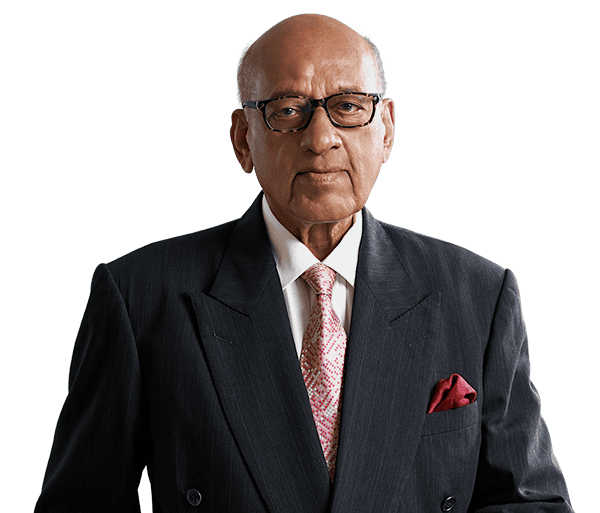
Who Was the Man in Brown? (Justice VC George)
He was mistaken for an interpreter, a hotel manager, an ugly judge, and a corpse. Then the scoreboard got it wrong too.
I was a junior. I had been sent to get an adjournment.
I reached the court at half past eight. A tall Indian gentleman sat at the interpreter’s desk poring over a foolscap book. Brown jacket, brown trousers, brown shoes.
So I took him for the interpreter. I gave him a cursory nod as I passed, took my seat at counsel’s table, crossed my legs, and opened the newspaper.
I would like it noted that I crossed my legs. In Asia, that is not considered polite.
Regarding me over the rim of his glasses, he nodded back. He said nothing at all.
The brown troubled me for a while. Interpreters wore black. Everyone wore black. Brown, in that building, was a sartorial aberration—a theory I considered, but dismissed.
Then a gentleman and a lady came in, both suited, and sat down where the interpreters sit. My theory had a difficulty.
At exactly nine o’clock, the man in brown cleared his throat.
“Good morning. How many of you are from outstation, and how many are local?”
Hands went up.
“How many require an adjournment, and how many wish to proceed?”
More hands.
“The hearing list is now revised. Adjournments without objection: numbers one, two, three. Objected applications: five, six, seven. Outstation counsel arguing an application take priority. Kuala Lumpur counsel wait until after twelve.”
Then, mercifully: “Those with later hearings may take a break, and return precisely at 11.30.”
It was the most efficiently run court I had ever sat in. I had just declined to acknowledge the man running it.
The Man Was Not the Interpreter
He was Tan Sri Vadaketh Chacko George — VC George.
What I had watched was not a judge being brisk. It was case management, some twenty years before anybody in this country thought to give it a name.1Mahadev Shankar, Vinayak Pradhan, Tommy Thomas, Kamraj Nayagam, Brendan Navin Siva, Lim Chee Wee and Chacko Vadaketh George, ‘Citation for V C George, Recipient of the Malaysian Bar Lifetime Achievement Award 2017’ (Malaysian Bar, 4 April 2017) https://www.malaysianbar.org.my/article/news/bar-news/news/citation-for-v-c-george-recipient-of-the-malaysian-bar-lifetime-achievement-award-2017. Unless otherwise stated, biographical detail comes from this citation.
It arrived formally under Tun Dzaiddin CJ, and became standard under Tun Zaki CJ. George had simply worked out that a man who drove from Ipoh should not sit behind a man who walked from Jalan Raja Chulan. Nobody gave him a practice direction. It did not occur to him to wait for one.
Nor, It Turns Out, Was He Dead
Being mistaken for other people has followed him about.
Posted to Kuantan as a High Court judge, he found the judiciary owned no official residence. He was put up at the Hyatt, and stayed there.
“After two years,” he says, “people started mistaking me for the general manager of the Hyatt.”2‘VC George, smalltown boy who became a legal giant’ (Free Malaysia Today, 13 May 2024) https://www.freemalaysiatoday.com/category/leisure/2024/05/13/vc-george-smalltown-boy-who-became-a-legal-giant.
Lat, the cartoonist, and an old friend from the Selangor Club, used him as the model whenever he drew a judge — bald, heavy-nosed, unflattering. George objected. Lat explained it was not him, merely “one of the ugly judges.”3Diana Khoo, ‘Tan Sri V C George releases book containing 100 humorous anecdotes about his life in legal practice’ (Options, The Edge, 3 April 2021) https://www.optionstheedge.com/topic/culture/tan-sri-v-c-george-releases-book-containing-100-humorous-anecdotes-about-his-life.
Then, in March 2017, at the Bar dinner where he received the Lifetime Achievement Award, two lawyers at the next table worked their way through his citation without placing him.
“Who is Chris talking about?”
“The retired judge, V C George.”
“Good heavens. Is he dead?”
He is not. He turns ninety-six this December, and he told that story himself, at the microphone, about ten minutes later.4V C George, ‘Acceptance Speech by V C George, Recipient of the Malaysian Bar Lifetime Achievement Award 2017’ (Malaysian Bar, 17 April 2017), delivered 18 March 2017 https://www.malaysianbar.org.my/article/news/speeches/speeches/acceptance-speech-by-v-c-george-recipient-of-the-malaysian-bar-lifetime-achievement-award-2017. A lesser man would have let it go.
The Plaque That Went Up, and Came Down
He has been doing this to himself for sixty years.
In Seremban, he won a damages claim for a towkay, who thanked him properly: a heavy ebony plaque, gold Chinese characters, reading, roughly: his tongue is that of the dragon, his roar is that of the lion.
He and his partner hung it up with some ceremony. He calls it “a not so subtle form of advertisement” — which is one way of describing something advocates are forbidden by their own profession to do.
Then the appeal came on. Mahadev Shankar appeared against him and, in George’s own account, “brilliantly conned the Federal Court into allowing the appeal.”5Acceptance Speech (n 4).
“The wretched towkay thereupon took back the plaque.”
A man who hands you the instrument of his own deflation has left you very little to work with.
“I Am Not Speaking About You.”
My own business that morning was an adjournment, in chambers, in a company matter I barely understood. I was red behind the ears, and it showed.
He looked at my face, and knew.
Sitpa Selvaratnam took the objection — clinical and brief, as always. In three and a half minutes the whole matter was laid out: the case, the objection, why the hearing should proceed.
George’s face began to cloud. “I think this is most unfair and improper.”
I must have turned pale, because he stopped, turned to me, and said the thing I have never forgotten.
“I am sorry. I am not speaking about you, Mr Ganesan. I am speaking about counsel.”
The adjournment had been sought at the eleventh hour because leading counsel was in another court — a thing leading counsel are prone to be. He granted it, observed it should be the last of its kind before him, and moved on.
I reported back to Gopal Sri Ram, the head of my firm. He looked at the ceiling, breathed in and out, and said nothing whatsoever.
I left that court certain I had been marked down as a young man of no grace and no business being there. What had actually happened was that a judge had taken careful aim at his displeasure, and fired it clean over the head of the boy standing in front of him.
The Chef, the Sow, and the Note Sent Up the Lectern
In January 1981, newly elevated to the High Court, George was posted to Kuantan for what he was told would be three months. It lasted two years.
To fill the long evenings, he started a dining club — senior civil servants, officers from the military base, most of them Muslim. Each month a chef, local or foreign, would explain the menu.
One evening the chef was German, and grew rhapsodic on the subject of truffles — how the finest were still hunted, in those years, by farmers walking female pigs on ropes through the forest, the sow drawn to the buried fungus by a scent she mistook, with some justification, for something else entirely.
George sent a note up to the lectern. Eleven words: you are addressing a group of Muslim gentlemen; do not speak about pigs.
The chef read it without breaking stride. “I was saying that we used pigs — but sorry, what we did was, we used dogs.”
Notice what the judge had actually done. He corrected nobody. He wrote eleven words and sent them forward, so his guest would not humiliate himself in front of twenty people.
It is the same gesture, exactly, as I am not speaking about you, Mr Ganesan. Take the sting upward, or sideways, or onto yourself. Never onto the man in front of you, who cannot answer back.
The Judge Who Would Not Let Go of the Score
The joking stops here, and this part is usually told wrongly.
In August 1987, the Leader of the Opposition, Lim Kit Siang, went to court to stop United Engineers (M) Bhd signing the contract to build the North–South Highway. The company was linked to UMNO. The Prime Minister had chaired the committee that awarded the job.
Lim sought an injunction in Penang. It was refused by Edgar Joseph Jr J.6Report of the Panel of Eminent Persons to Review the 1988 Judicial Crisis in Malaysia (Malaysian Bar, 2008) para 2.10 https://www.malaysianbar.org.my/cms/upload_files/document/PanelofEminentPersonsReport.pdf. The Supreme Court granted it a week later, on appeal.
UEM and the Government then applied to the Kuala Lumpur High Court to set the injunction aside and strike out the suits. That application came before V C George J.
On 5 October 1987, he dismissed it.7Lim Kit Siang v United Engineers (M) Bhd [1988] 1 MLJ 50 (HC, V C George J), Civil Suit No D3-21-11-87; Panel of Eminent Persons (n 7) para 2.12. He held that the Opposition Leader had standing, and that there were serious issues to be tried. On the material before him, he found that every member of the awarding committee — the Prime Minister included — had, on the face of it, committed an offence under the Prevention of Corruption Act.8Shaila Koshy, ‘A salute to George’ (The Star, 9 April 2017) https://www.thestar.com.my/news/nation/2017/04/09/a-salute-to-george-retired-court-of-appeal-judge-tan-sri-vadaketh-chacko-george-is-not-just-a-pretty.
A judge of first instance wrote that down, signed it, and let it go out into the Malaysia of 1987. The man had spent his career being taken for somebody unimportant. It turns out this was not because he was.
Three Against Three
The Supreme Court reversed him on 15 January 1988, by three votes to two.9Government of Malaysia v Lim Kit Siang [1988] 2 MLJ 12 (SC). Salleh Abas LP led the majority, though he took the trouble to say: “I can see no error of any kind in the judgment of V.C. George J.”
The two who would have upheld him were Eusoffe Abdoolcader SCJ and George Seah SCJ.
Abdoolcader is a name worth stopping over. He taught himself Latin as a grown man. He dissented where it cost him, and was proved right after his death, when the courts came back to his reasoning a quarter-century later.10For the doctrine’s later vindication, see the Federal Court’s own engagement with Abdoolcader SCJ’s reasoning in subsequent locus standi jurisprudence, discussed in the Panel of Eminent Persons Report (n 7) and in the secondary commentary it collects. If you want to know what a dissent is truly for, begin with his in Lim Kit Siang, and read it beside the majority. It is nine pages that took twenty-five years to be believed.
Anybody who has watched cricket on the padang knows the scoreboard tells you less than it appears to. Runs, wickets, overs. Not the ball that kept low, not the catch put down, not the appeal the umpire waved away. The board tells you who won.
It does not tell you who was right.
George has spent thirty-eight years quietly correcting the board. Asked about the reversal at eighty-six, he said: “The Supreme Court panel then — Salleh, Hamid and Hashim Yeop Sani — held Kit Siang did not have locus standi and allowed the Government’s appeal. But Eusoffe Abdoolcader and George Seah held that my judgment was the correct one. So in effect, it wasn’t a majority judgment but three against three.”11Koshy (n 9). The interviewer records the remark as tongue-in-cheek.
He counts himself.
The man who let a whole country mistake him for the interpreter, the hotel manager, an ugly judge and a corpse declines, on this one point only, to be left off the list. It is delivered as a joke, and it is not one. He is refusing, after sixty years in the law, to agree that the scoreboard is the argument.
Seven months after that judgment was handed down, the Lord President who wrote it was removed from office.
George has never drawn that line himself. He has never needed to.
What He Was Actually For
Ask him to name his best judgment, and he declines the famous one.
“Everyone seems to think the highlight of my career was the UEM case,” he says, “but there were others which dealt with equally important points.”12Koshy (n 9).
He names a land acquisition case from Pahang instead. The State had issued its second notice six years after the first, offering compensation at the old price. Land in Pahang had not stood still for six years. Neither, he held, had the Constitution’s guarantee of adequate compensation.13Koshy (n 9), on Oriental Rubber and Oil Palm Sdn Bhd v Pemungut Hasil Tanah Kuantan (1983).
Then the sentence that tells you what he thought a judge was for: “Those cases cost the State millions and millions of ringgit. After that they gave the people adequate compensation.”
Not the principle. The consequence, for people who owned land in Pahang and had never heard of him.
Asked to sum up fifteen years on the Bench, he managed it in nineteen words: “I don’t think any litigant came to my court and thought he had been shortchanged.”14Koshy (n 9). There are longer statements of the judicial function. There is not a better one.
The Act He Wrote, and Was Called Back to Defend
Before the Bench there was the Bar. He was its eighth President, and chaired the sub-committee that drafted the Legal Profession Act 1976 — the statute still governing every advocate and solicitor in this country.
Notice how he tells it. The heavy lifting, he says, was done under Chan Hua Eng, his predecessor, “who had driven us hard into attempting to complete the thing, and complete it we did.”15Acceptance Speech (n 4). A man who wanted the credit had it there for the taking. He put it in a subordinate clause.
Thirty years on, I objected to amendments being made to that same Act, and requisitioned an extraordinary general meeting. A committee was appointed, with the retired Dato’ V C George at its head, and named after him. The man who wrote the Act in 1976 was fetched back in 2006 to defend it from what was being done to it.
After three sittings, he said this to me over tea: “I have been warned by several people that you are given to strong opinions, entrenched on every point, that you cannot be negotiated with.”
Then he looked at me. “I realise now that I was wrong to have judged you before I had even met you.”
Then he said something complimentary. It had something to do with “being an English gentleman.”
And every time we broke for tea across those weeks, he told a story, always at his own expense, never at anybody else’s. Exceedingly funny. Of course you could not laugh, because you were in the middle of amending a statute.
The report was finally complete. It was overseen by Sir Peter Mooney and seven other colleagues. One, Datuk Vazeer Alam, went on to the Federal Court. At the end, VC proofed it and did not amend anything save to correct one of his own comments with the words: “That is a mite impolitic, don’t you think?”
The Artist Who Could Not Pay
Years later, after I wrote a book on bankruptcy, the telephone rang one evening. A friend of theirs, a great artist, needed a discharge and could not afford one. Would I help, asked George.
I did, and in time the order was made. When he heard of it, he took Mala and me, and the lawyers of my firm, to lunch at the Selangor Club. That was how he settled the bill for work he had asked me to do for nothing.
Whenever I told Mala we were seeing him, her face lit up. His greeting never varied. First the insult — “Good heavens, GK, what on earth are you doing here with these pirates?” — and then, once you had absorbed it, the kind things. Always in that order.
No Dirty Jokes, Please
At the eightieth birthday of a scholar friend of ours, somebody had got to him beforehand. Tan Sri, no dirty jokes, please.
“Fine,” he said.
When his turn came, he made his way slowly to the microphone, drew himself to his full height, and began: “I have been told not to make any dirty jokes. I will make one now.”
Ten seconds of material. Five minutes of a room unable to recover.
He is still there — a consultant at his old firm, ninety-three when last interviewed on the record, and the author, at ninety, of a hundred such stories, published under his own name.16Free Malaysia Today (n 2), recording him at ninety-three; Khoo (n 3), on the first edition of the book. His reason for publishing them is the finest lawyer’s joke in the book, and it is not offered as one: “My stories are supposed to be stories about real people, and there is the danger that somebody may sue me for defamation. I am, after all, a lawyer… My advice to any publisher is not to touch this with a barge pole.”17Khoo (n 3). Delivered, the interviewer records, completely deadpan. He then gave the proceeds away.
The Man Who Taught Him How to Dress
In April 1952, a young man who could not afford university sailed into a snow-covered Tilbury Docks and went straight into Lincoln’s Inn, because in those days one could. There he made a friend who taught him how to dress like a lawyer.
That friend became Sultan Azlan Shah. Seventy years on, when the hundred stories appeared, it was that friend’s son, Sultan Nazrin Muizzuddin Shah, who came to the Royal Selangor Club to launch the book.18‘Retired veteran judge Tan Sri V.C. George launches second edition of memoir’ (The Vibes, 4 December 2022) https://www.thevibes.com/articles/culture/79162/retired-veteran-judge-tan-sri-v.c-george-launches-second-edition-of-memoir; ‘Web Report | Cheque Presentation and Book Launch by V C George (3 Dec 2022)’ (Malaysian Bar) https://www.malaysianbar.org.my/article/news/bar-news/news/web-report-cheque-presentation-and-book-launch-by-v-c-george-3-dec-2022-.
The lesson in dressing appears to have taken.
Are We Proud of the Judiciary We Have?
Asked in 2024 about the state of the courts, he did not mention 1988 at all. He named the judges then sitting whom he admired, and said we should be very proud of the judiciary we have.19Free Malaysia Today (n 2).
That is not a man nursing a grievance. That is a man who kept his own score privately for thirty-eight years, and found at the end that he had never needed it.
Wherever he went, VC George brought joy and laughter and light, and he never once put another person down. He mentions, in passing, that his relatives have all lived comfortably past a hundred.
By that reckoning he is middle-aged, and has some way to go.
Long may he live — and long may V C George go on mistaking himself, out loud, for somebody else’s punchline.
∞§∞
This article is written for a general readership and does not constitute technical or legal advice. Readers with legal questions are encouraged to seek independent legal advice.
The author thanks KN Geetha, TP Vaani, JN Lheela, and Lydia Jaynthi at GK Legal.
Our gratitude to Messrs Skrine & Co for the image.
Claude, Anthropic’s AI, smoothed the drafting; Perplexity Pro checked the facts. The argument, the views, and the errors remain the author’s.
@Copyright reserved.
All content on this site, including but not limited to text, compilation, graphics, documents, and layouts, is the intellectual property of GK Ganesan Kasinathan and is protected by local and international copyright laws. Any use shall be invalid unless written permission is obtained by writing to gk@gkganesan.com.